
JSW Pragathi roofing sheets are increasingly chosen for homes, villas, farmhouses and light commercial buildings in regions where summer temperatures stay high for months at a time. In places like Tamil Nadu, a roof may sit under direct sun for eight to ten hours a day, with surface temperatures climbing far above the air temperature around it.
Heat does not usually break a metal roof in a single season. It works slowly, through daily expansion and contraction, gradual fading of the paint, and stress on fasteners and washers.
How well a roof handles that daily cycle is what thermal stability really means in practice.
Homeowners and builders who want to see colours and profiles before deciding often visit Crayon Roofings & Structures, an authorized distributor of JSW colour coated sheets with a JSW Experience Centre at its facility. Choosing a sheet that suits the local climate, and detailing it correctly, matters as much as the brand printed on it.
So how do JSW Pragathi sheets behave in hot climates, and what helps them perform well over time?
What Is JSW Pragathi?
JSW Pragathi, marketed by JSW as JSW Pragati+, is a colour coated roofing sheet made from aluminium-zinc coated steel. JSW pitches it at homes, villas, farmhouses and smaller commercial buildings where budget matters as much as appearance.
Based on JSW’s published product information, the range offers:
- An aluminium-zinc metallic coating, which JSW states gives around twice the corrosion resistance of conventional galvanised sheets
- A colour coated finish in a wide choice of vibrant and neutral shades
- Thicknesses from about 0.25 mm to 1.5 mm
- Widths up to 1440 mm and lengths up to 12 metres
- Trapezoidal and tile-style profiles, along with matching ridges, flashings and gutters
JSW describes the range as suitable for all climates, from coastal humidity to intense heat. The rest of this blog looks at what that means on a real roof.
How Heat Acts on a Metal Roof
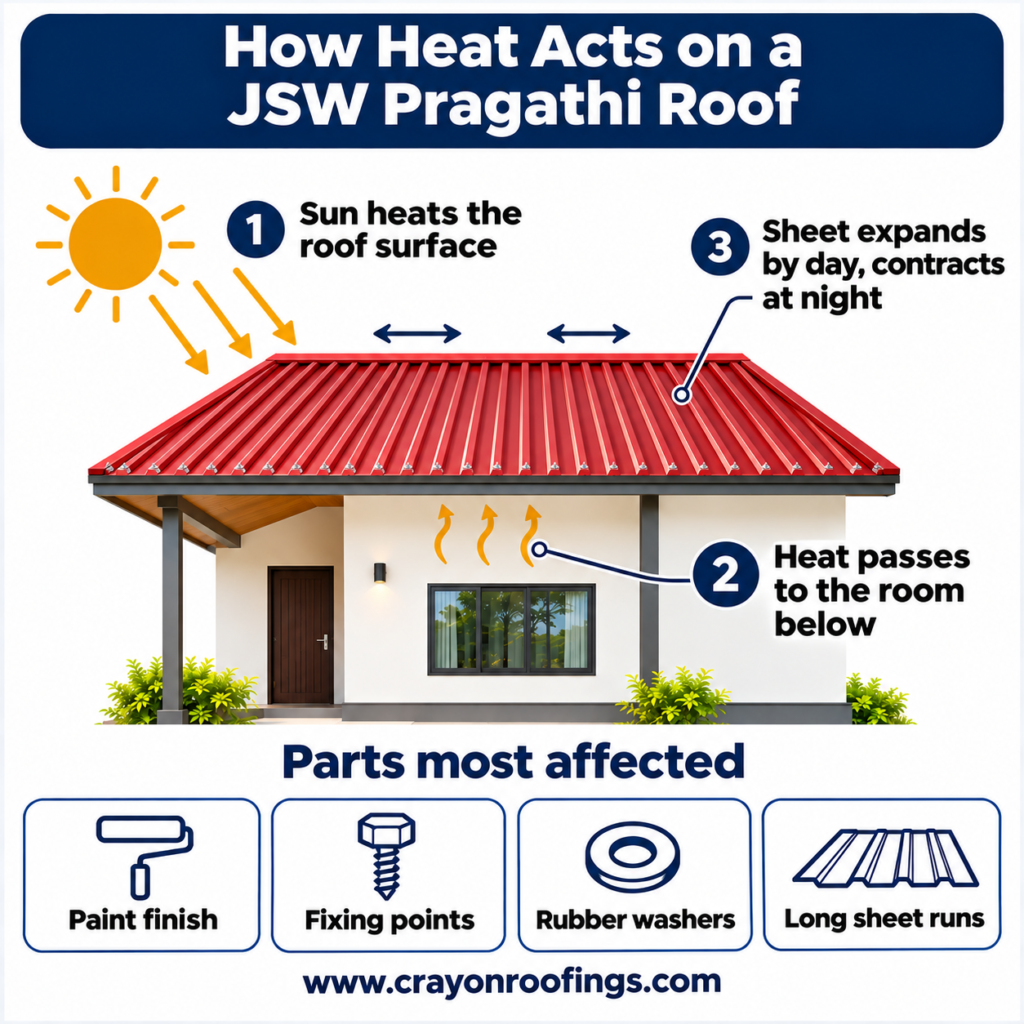
A metal roof in a hot climate deals with heat in three ways at once.
The sun heats the top surface directly. The sheet then passes part of that heat to the space below. And because steel expands when it warms and contracts when it cools, the sheet moves slightly every single day.
On a clear summer afternoon, a dark roof surface can become far hotter than the surrounding air, while a light-coloured surface stays noticeably cooler. At night, the sheet cools again. This repeated heating and cooling, rather than any one hot day, is what tests a roof’s long-term stability.
The parts most affected are:
- The paint finish, which can fade or chalk under constant UV and heat
- Fixing points, where movement is concentrated
- Rubber washers, which can harden over time in strong sun
Long sheet runs, where movement adds up along the length
How the JSW Pragathi Coating Handles Heat
The aluminium-zinc layer under the paint does most of the protective work. Aluminium forms a stable barrier that slows corrosion, while zinc protects cut edges and scratches. Compared with a plain zinc coating, an aluminium-zinc coating is generally more tolerant of sustained heat and holds its protective qualities well in warm, humid conditions.
Over this metallic layer sits the paint system, which gives JSW Pragathi its colour and its first line of defence against UV. How these layers stack up on a roofing sheet is explained in our blog on the roofing layers in metal roofing sheets.
For homes and light commercial buildings, this combination offers a good balance of protection and cost. For buildings with very high internal heat, such as foundries or furnace sheds, a higher specification sheet is usually a better fit.
Choosing JSW Pragathi Colours for Hot Climates
Colour has a direct effect on how hot a roof becomes.
Lighter colours reflect more sunlight and absorb less heat, so the sheet runs cooler and moves less through the day. Darker colours absorb more heat, which raises surface temperature, increases daily movement and can make fading more noticeable over the years.
| Colour Group | Heat Absorption | Effect in Hot Climates |
| White and off-white | Low | Coolest surface, least daily movement |
| Light grey and light blue | Low to moderate | Good balance of looks and comfort |
| Green and terracotta | Moderate | Popular for homes, slightly warmer roof |
| Dark brown and deep red | High | Hottest surface, fading more visible over time |
For homes in hot regions, many buyers choose a lighter roof and use darker JSW Pragathi shades for trims, gables or wall cladding, where heat matters less. Viewing the actual colours in daylight before ordering helps avoid surprises.
Managing Thermal Expansion on JSW Pragathi Roofs
Steel roofing sheets grow slightly longer as they heat up. The change on a single sheet is small, but on long runs from ridge to eave it adds up.
If this movement is restrained, it can show up over time as:
- Elongated or loosened fixing holes
- Small waves or ripples in the pans
- Stress on overlaps and flashings
- Leaks at fasteners after a few seasons
The way metal buildings are designed to absorb this movement is explained in Metfraa’s blog on thermal expansion challenges in pre-engineered metal buildings.
On homes and smaller buildings, simple steps go a long way. Keeping sheet lengths sensible, using the correct fastener spacing and allowing proper laps all help JSW Pragathi sheets move without strain.
Supporting Structure and Fixings in Hot Weather
A roof is only as stable as the frame and fixings beneath it.
Purlins carry the sheet and take the load from every fastener. In many conventional sheds and homes, hot-rolled MS channels are used as purlins, and correctly sized, well-aligned members give the fasteners firm material to grip.
For hot climates, a few fixing details matter most:
- Self drilling screws with good quality EPDM washers that stay flexible in heat
- Screws driven straight and to the correct depth, without crushing the washer
- Fastener coating compatible with the aluminium-zinc sheet
- Closer fixing at eaves, ridges and corners, where wind and movement are greatest
Washers that harden and crack are one of the most common reasons metal roofs start leaking after a few hot summers.
Keeping Homes Cooler Under JSW Pragathi Roofs
Thermal stability is also about comfort inside the building.
A colour coated roof on its own will pass some heat to the rooms below, especially in the afternoon. Several simple measures help:
- Choosing a lighter roof colour
- Adding ventilation at the ridge so hot air can escape
- Using under-deck insulation or a false ceiling in living spaces
- Keeping a small air gap between the sheet and any ceiling below
- Planting or shading on the west side, where afternoon sun is strongest
Combined with the right JSW Pragathi colour, these measures can make a clear difference to indoor temperatures during summer.
Maintaining JSW Pragathi Sheets in Hot Regions
Hot climates usually come with dust, and sometimes with salt air near the coast. Light, regular care helps the finish last:
- Wash the roof once or twice a year to remove dust and deposits
- Clear leaves and debris from valleys and gutters
- Check fasteners and washers after the first summer and tighten or replace where needed
- Remove metal swarf after any drilling, as it can rust and stain the paint
- Touch up any scratches promptly to protect the coating beneath
Common Mistakes When Using Colour Coated Sheets in Hot Climates
- Choosing a very dark roof colour without thinking about heat
- Using very long single sheets without allowing for movement
- Using cheap screws whose washers harden quickly in sun
- Over-tightening fasteners, which restricts movement and damages washers
- Skipping ventilation and insulation in living spaces
- Ignoring small leaks at fixings until they spread
How Should You Plan a JSW Pragathi Roof for a Hot Climate?
Step 1: Understand the building and climate Note how many hours of direct sun the roof gets and whether the site is near the coast.
Step 2: Choose a suitable colour Prefer lighter shades for the main roof and use darker JSW Pragathi colours for trims or walls.
Step 3: Select thickness and profile Match the sheet thickness and profile to the purlin spacing and span.
Step 4: Plan sheet lengths and laps Keep runs practical and allow proper overlaps so the sheet can move with temperature.
Step 5: Use quality fixings Choose self drilling screws with heat-resistant EPDM washers and compatible coatings.
Step 6: Add ventilation and insulation Plan ridge ventilation and insulation for comfort in living and working spaces.
Conclusion
JSW Pragathi roofing sheets offer a practical, value-focused option for homes, villas, farmhouses and light commercial buildings in hot climates. Their aluminium-zinc coating and colour coated finish give good protection against heat and humidity when the roof is planned with the climate in mind.
Thermal stability depends on more than the sheet itself. Colour choice, sheet length, fixings, purlins, ventilation and simple maintenance all decide how well the roof copes with years of daily heating and cooling.
With the right colour and correct detailing, a JSW Pragathi roof can stay stable, weathertight and good-looking through many hot summers. As an authorized distributor of JSW colour coated sheets, Crayon Roofings & Structures helps buyers choose suitable colours, profiles and accessories, and has experience supporting residential and commercial roofing projects in hot climates.
If you are planning a roof and want to know whether JSW Pragathi suits your building, contact us at Crayon Roofings & Structures to discuss your requirements.
Frequently Asked Questions
1. Can I see JSW Pragathi colours at Crayon Roofings & Structures before ordering?
Yes. Crayon Roofings & Structures is an authorized distributor of JSW colour coated sheets, with a JSW Experience Centre to view colours and profiles.
2. Is JSW Pragathi suitable for hot climates?
Yes. Its aluminium-zinc coating handles heat and humidity well, especially when lighter colours, proper fixings and ventilation are used.
3. Which JSW Pragathi colour keeps a roof cooler?
White, off-white and light grey shades reflect more sunlight, keeping the roof surface cooler and reducing daily expansion.
4. Which factors should be considered when selecting JSW Pragathi for a hot climate?
Colour, thickness, profile, sheet length, purlin spacing, fastener quality, ventilation and insulation should all be considered before ordering.