
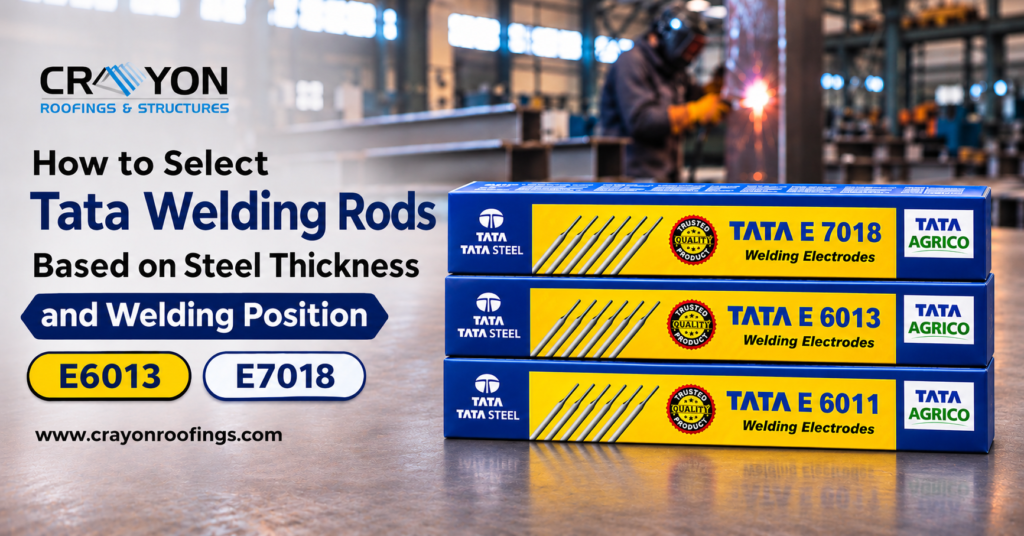
Tata Welding Rods give the best results when the rod size and type are matched to two things: how thick the steel is and the position in which the joint will be welded. A rod that works perfectly on a flat 6 mm fillet can be difficult to control on an overhead cleat, and a rod sized for thin sheet will take far too many passes on a heavy base plate.
Most welding problems in fabrication yards, such as burn-through, poor penetration, sagging beads and excessive spatter, trace back to this choice rather than to the rod itself.
Getting the selection right at the start saves rework, grinding time and rejected joints.
Fabricators looking for consistent consumables often turn to Tata Agrico products through Crayon Roofings & Structures, an authorized Tata Agrico distributor for welding electrodes, self-drilling screws and grinding wheels, and also an authorized distributor of JSW colour coated sheets. A genuine rod is the starting point. Using the right diameter and technique for each joint is what turns it into a sound weld.
So how should you choose Tata Welding Rods for different plate thicknesses and welding positions?
Understanding Tata Welding Rods and Their Classification
Tata Welding Rods are covered electrodes made under the Tata Agrico brand of Tata Steel, used for manual metal arc welding, often called stick welding.
The most widely used type in general fabrication is the E6013 mild steel electrode. In this classification:
- E stands for electrode
- 60 indicates a minimum weld metal tensile strength of about 60,000 psi
- 1 means the electrode is suitable for all welding positions
- 3 refers to the coating type and the current it can run on, which for E6013 is a rutile coating suited to AC or DC
Product listings for Tata Welding Rods describe them as made from prime steel wire rods, with low spatter, low smoke emission and low electricity consumption, and an ISI grade option is also available. Common sizes include 2.5 mm, 3.15 mm and 4.0 mm, in lengths of 350 mm and 450 mm.
Because the “1” in E6013 means all-position use, the same Tata Welding Rods can be used flat, horizontal, vertical and overhead. What changes from one position to another is the rod diameter, the current and the technique.
Why Steel Thickness Decides the Rod Diameter
The rod diameter controls how much heat and filler metal go into the joint.
A larger diameter carries more current, melts faster and deposits more metal per pass. That suits thicker steel, which can absorb the heat without distorting or burning through. A smaller diameter runs cooler and slower, which gives better control on thin sections.
If the chosen diameter is oversized for the section:
- Thin sheet can burn through
- The weld pool becomes hard to control
- Distortion increases on light sections
If the chosen diameter is undersized for the section:
- Penetration into thick plate may be insufficient
- More passes are needed, adding time and cost
- Lack of fusion becomes more likely at the root and sidewalls
A simple working rule used in many shops is that the rod diameter should generally not exceed the thickness of the thinner part being joined, particularly for the first pass.
Tata Welding Rods Size Guide by Steel Thickness
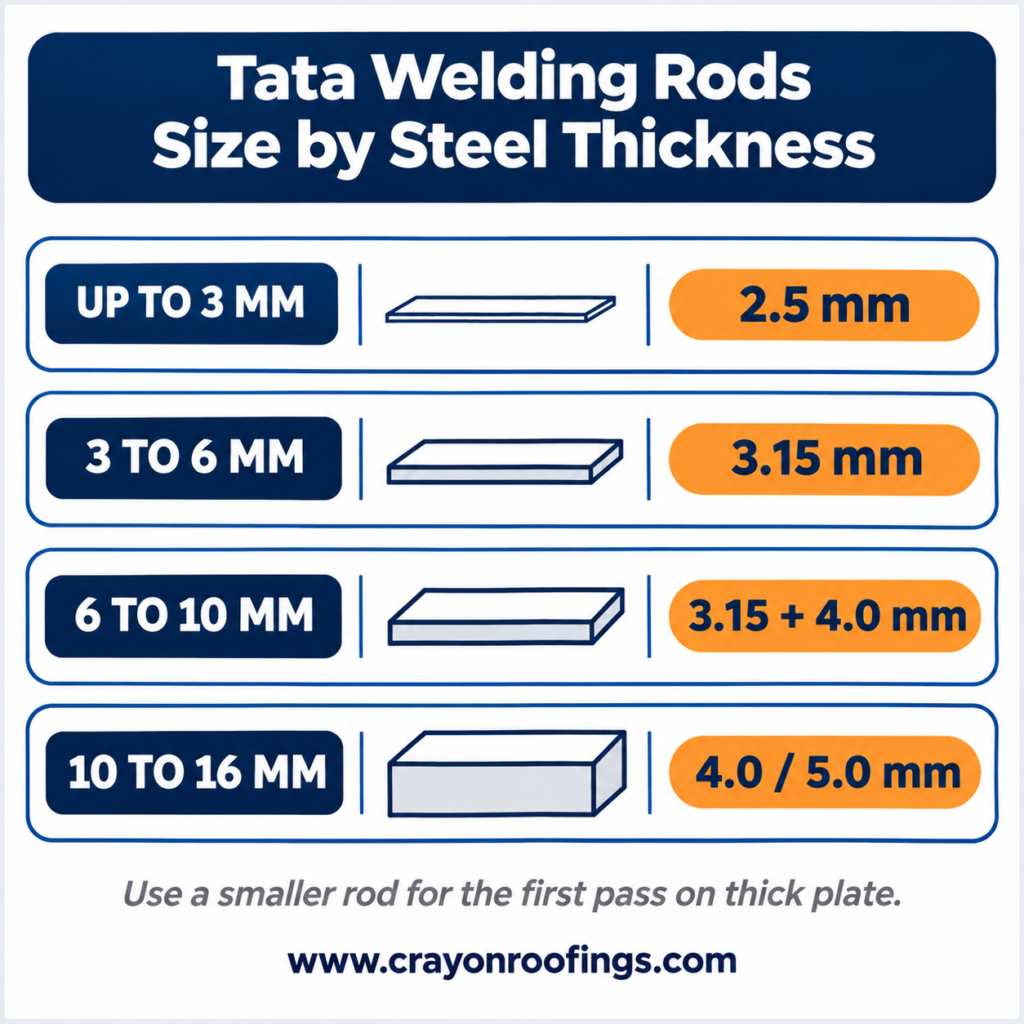
Tata Welding Rods should be sized to the thickness of the steel being joined. Rod diameter decides how much heat and filler metal goes into the joint. A thin rod gives control on light sheet, and a thicker rod fills heavy plate faster with fewer passes.
On plates above 6 mm, the joint is usually built up in layers. A smaller rod lays the root pass to get full fusion at the bottom of the joint, and larger rods then fill and cap it. This is why the chart shows two sizes for thicker plate.
As a typical starting point for mild steel:
- Up to 3 mm: 2.5 mm rod, single pass at low current
- 3 to 6 mm: 3.15 mm rod, one or two passes
- 6 to 10 mm: 3.15 mm root pass with 4.0 mm fill
- 10 to 16 mm: 3.15 mm root pass with 4.0 or 5.0 mm fill, on V-prepared edges
Joint design, edge preparation and the approved welding procedure have the final say on rod size.
For fillet welds, the leg size required by the drawing also influences the number of passes. A larger fillet on thick plate is usually built up in layers rather than attempted with one oversized rod.
The thickness and grade of the plate itself should be confirmed before welding starts. Clear thickness and grade details on MS plates make rod selection much more straightforward.
Typical Current Ranges for Tata Welding Rods
Each rod diameter works within a current range. Running too low causes sticking and poor fusion, while running too high causes spatter, undercut and overheating of the rod.
| Rod Diameter | Typical Current Range (Amps) |
| 2.5 mm | 60 to 90 |
| 3.15 mm | 90 to 130 |
| 4.0 mm | 130 to 170 |
| 5.0 mm | 170 to 230 |
These are indicative values for E6013 electrodes. The range printed on the Tata Welding Rods packet should always take priority, and settings are usually reduced by around 10 to 20 percent for vertical and overhead positions.
Selecting Tata Welding Rods by Welding Position
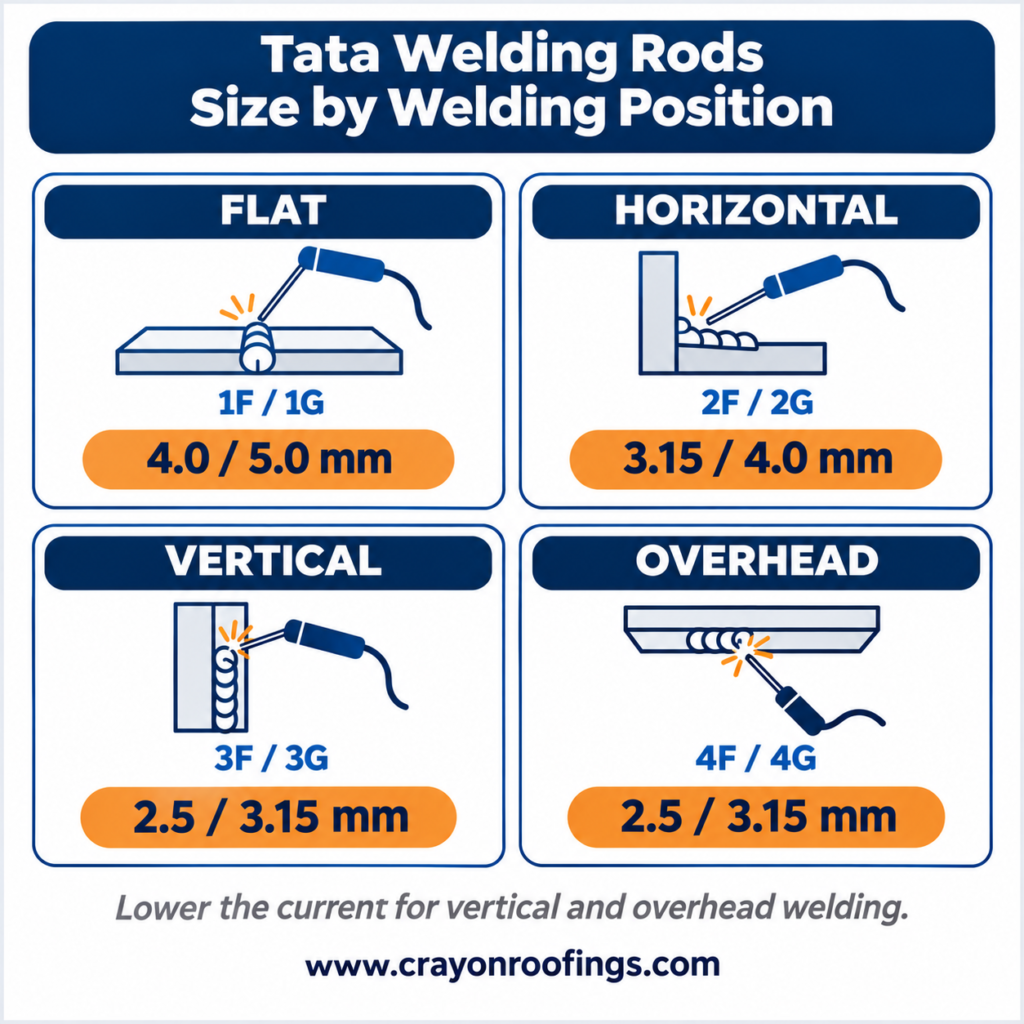
Welding position changes how gravity acts on the molten pool. In the flat position, gravity helps hold the pool in the joint. In vertical and overhead positions, it works against the welder.
Flat Position (1F / 1G)
The flat position is the easiest and most productive. Larger Tata Welding Rods, such as 4.0 mm and 5.0 mm, can be used on suitable thickness to deposit more metal per pass. Base plates, flanges laid on a bench and fabricated assemblies turned for downhand welding are typical examples.
Horizontal Position (2F / 2G)
In horizontal welding, the pool tends to sag towards the lower plate. A 3.15 mm or 4.0 mm rod with a slight upward angle helps keep the bead even. Column-to-base plate fillets and stiffeners on vertical members often fall in this position.
Vertical Position (3F / 3G)
Vertical welding needs more control. Smaller Tata Welding Rods, usually 2.5 mm or 3.15 mm, with reduced current, allow the welder to manage the pool. Vertical-up welding gives better penetration on structural joints, while vertical-down is faster but generally limited to thin material and non-critical joints.
Overhead Position (4F / 4G)
Overhead is the most demanding position. A 2.5 mm or 3.15 mm rod, lower current and a short arc help prevent the molten metal from dropping. Purlin cleats fixed after erection, bracing connections and site repairs are common overhead situations.
Combining Thickness and Position in One Decision
In practice, thickness and position have to be considered together. A 10 mm plate welded flat can use a 4.0 mm rod for the fill passes, but the same thickness welded overhead is usually completed with 3.15 mm rods and more passes.
| Situation | Suggested Rod | Reason |
| Thin sheet, any position | 2.5 mm | Prevents burn-through and distortion |
| 6 mm plate, flat | 3.15 mm or 4.0 mm | Good deposition with control |
| 6 mm plate, vertical or overhead | 3.15 mm | Easier pool control |
| 12 mm plate, flat | 3.15 mm root, 4.0 or 5.0 mm fill | Faster filling of the joint |
| 12 mm plate, vertical or overhead | 3.15 mm root and fill | Control matters more than speed |
On structural projects, these decisions are often planned at the fabrication drawing stage. The way fabrication fits into the overall building process is explained in Metfraa’s blog on the pre-engineered building process.
When Tata Welding Rods of Another Type Are Needed
E6013 Tata Welding Rods are well suited to general mild steel fabrication, light structures, gates, frames, cleats and many secondary structural joints.
However, some joints may call for a different electrode type, often a low hydrogen electrode, as specified by the designer or the welding procedure. These typically include:
- Heavily loaded primary connections
- Thick sections where cracking risk is higher
- Joints subject to fatigue or dynamic loading
- Higher strength steels
The drawing or welding procedure specification should always be followed where it names a particular electrode.
Practical Tips for Better Welds with Tata Welding Rods
A few habits make a noticeable difference to weld quality:
- Keep a short arc, roughly equal to the rod diameter
- Clean rust, oil, paint and moisture from the joint before welding
- Remove slag fully between passes
- Store opened packets in a dry place, as damp rods cause porosity and spatter
- Tack long joints at intervals to control distortion
- Use the same brand and size consistently across a job for predictable results
More practical guidance on electrode use is available on Crayon’s Tata mild steel electrodes blog page.
Common Mistakes When Choosing Tata Welding Rods
Several errors appear repeatedly in fabrication work:
- Using one rod size for every thickness and position
- Running vertical and overhead welds at flat-position current
- Using a large rod for the root pass on thick plate
- Ignoring the current range printed on the packet
- Welding thick sections in a single heavy pass
- Mixing genuine Tata Welding Rods with unknown electrodes on the same job
How Should You Select Tata Welding Rods for a Job?
Step 1: Check the steel thickness and grade Confirm the thickness of each part and use the thinner part as the guide for the first pass.
Step 2: Identify the joint type Note whether the joint is a fillet, butt or lap joint and whether edge preparation is required.
Step 3: Note the welding position Identify whether each joint will be welded flat, horizontal, vertical or overhead.
Step 4: Choose the rod diameter Select the diameter from thickness and position together, using smaller rods for vertical and overhead work.
Step 5: Set the current Start within the range on the packet and reduce it for out-of-position welding.
Step 6: Follow the welding procedure Use the electrode type specified on the drawing or procedure for critical joints.
Conclusion
Tata Welding Rods perform best when the rod diameter, current and technique are matched to the thickness of the steel and the position of the joint. Thin material and overhead or vertical welds call for smaller rods and lower current, while thicker plate welded in the flat position can take larger rods for faster deposition.
E6013 Tata Welding Rods cover a wide range of general and secondary fabrication work in all positions. Critical, heavily loaded or thick-section joints should follow the electrode named in the approved welding procedure.
A little planning before the arc is struck reduces rework, grinding and rejected joints. As an authorized Tata Agrico distributor, Crayon Roofings & Structures offers genuine welding electrodes along with grinding wheels and self drilling screws for fabrication and structural work.
If you need help choosing the right Tata Welding Rods for your next fabrication job, contact us at Crayon Roofings & Structures to discuss your requirements.
Frequently Asked Questions
1. Can I get genuine Tata Welding Rods from Crayon Roofings & Structures?
Yes. Crayon Roofings & Structures is an authorized Tata Agrico distributor, offering genuine Tata Welding Rods in common sizes for fabrication work.
2. Which Tata Welding Rods size suits 6 mm steel plate?
A 3.15 mm rod usually suits 6 mm plate in one or two passes, while 4.0 mm can be used for flat-position fillet welds.
3. Can Tata Welding Rods be used for overhead welding?
Yes. E6013 Tata Welding Rods are all-position electrodes, but 2.5 mm or 3.15 mm sizes with lower current give better overhead control.
4. Which factors should be considered when selecting Tata Welding Rods?
Steel thickness, joint type, welding position, rod diameter, current range and the approved welding procedure should all be checked before selection.