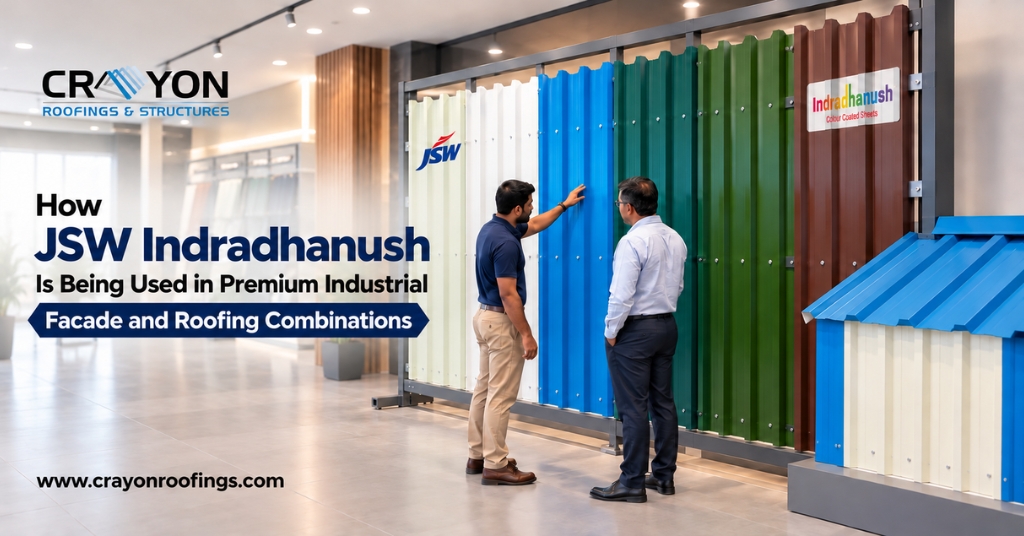
JSW Indradhanush is increasingly being specified where an industrial building is expected to look as considered as it is functional. Factory owners, warehouse developers and industrial park operators are paying closer attention to how the roof and the facade read together, particularly on buildings that face a highway, a client entrance or a shared industrial estate frontage.
Earlier, the roof was selected for performance and the wall cladding was added as a separate, often mismatched decision. That approach is changing.
Today, roof and facade are more often planned as one envelope, with colours, profiles and trims chosen together so the building presents a clean, consistent identity from the road.
Industrial buyers planning coordinated roofs and facades often work with Crayon Roofings & Structures, which supplies roof sheets, wall cladding, purlins and trims from its Chennai facility. Crayon is an authorized distributor of JSW colour coated sheets and also hosts a JSW Experience Centre, where colours and profiles can be seen in person before ordering. Picking an attractive shade is only the starting point. The sheet, profile and trims also need to suit the building’s exposure, so the finish lasts as well as it looks.
So how is JSW Indradhanush being used in facade and roofing combinations, and where does it fit best?
What Is JSW Indradhanush?
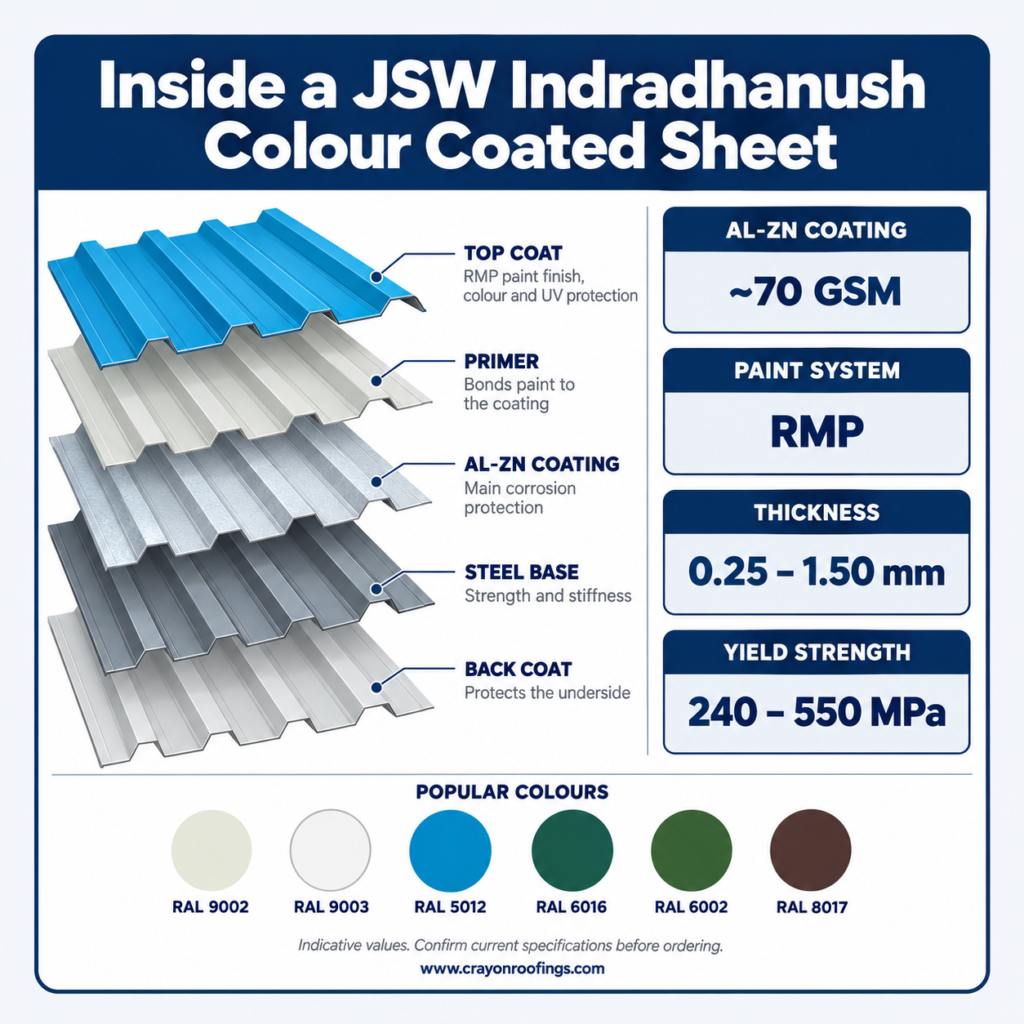
JSW Indradhanush is an aluminium-zinc coated, pre-painted steel sheet, commonly referred to as PPGL. The name means rainbow, which reflects the product’s broad colour range.
JSW Indradhanush is built in layers: a steel substrate, an aluminium-zinc metallic coating for corrosion protection, and a paint system on top for colour and surface protection. How these layers work together on a roofing or cladding sheet is explained in more detail in our blog on the roofing layers in metal roofing sheets.
Based on JSW’s published product data, Indradhanush is generally supplied with:
- An aluminium-zinc coating of around 70 GSM
- A paint finish based on regular modified polyester, commonly shortened to RMP
- Thicknesses ranging from about 0.25 mm to 1.50 mm
- Yield strength options from about 240 to 550 MPa
The JSW Indradhanush range is positioned for everyday roofing across residential and light commercial applications. On industrial buildings, its value lies largely in colour flexibility and cost efficiency, which is why it is often used as part of a combination rather than as the only sheet on the building.
Why Roof and Facade Are Now Specified Together
An industrial building is often judged first by its front elevation.
When the roof and wall cladding come from different batches, different suppliers or unrelated colour decisions, the building can look patched together even when it is structurally sound. Planning both together helps avoid that.
Specifying roof and facade as one package generally offers:
- A consistent colour scheme across the building envelope
- Matching trims, flashings and corner details
- Simpler procurement and delivery sequencing
- Fewer colour mismatches between phases
- A clearer brand presence for the occupier
For buildings in industrial corridors such as Sriperumbudur, Oragadam and Gummidipoondi, where many sheds sit side by side, a coordinated envelope is one of the simplest ways to make a facility stand out.
JSW Indradhanush Colour Combinations for Industrial Buildings
Most JSW Indradhanush combinations on industrial buildings use a light or neutral main body colour, with a stronger accent colour for the roof, trims, gable bands or entrance areas.
| Combination Approach | Main Wall Colour | Accent or Roof Colour | Typical Effect |
| Clean corporate | Off-white (RAL 9002) | Light blue (RAL 5012) | Bright, modern, easy to brand |
| Bright contrast | Pure white (RAL 9003) | Leaf green (RAL 6002) | Fresh appearance, strong visibility |
| Muted industrial | Off-white (RAL 9002) | Chocolate brown (RAL 8017) | Understated, hides dust well |
| Two-tone wall | Turquoise green (RAL 6016) band | Off-white (RAL 9002) body | Horizontal banding, breaks up large walls |
Lighter colours on roofs generally absorb less solar heat than darker colours, which is a practical consideration for Chennai’s climate. Darker shades are often kept for wall bands, trims and lower facade sections, where heat gain is less of a concern and dust or splash marks are less visible.
JSW Indradhanush Profile Combinations for Roof and Wall
Colour is only half of the combination. The profile defines how light falls on the surface and how the building reads from a distance.
Common approaches include:
- A deep trapezoidal profile on the roof for span and water carrying capacity
- A shallower or more closely spaced profile on the walls for a finer, more architectural look
- Horizontal cladding bands at specific heights to break up tall wall areas
- Matching profiles on roof and wall where a uniform appearance is preferred
When roof and wall profiles differ, the trims and corner flashings need careful detailing so that the transition between them looks deliberate rather than improvised.
Where JSW Indradhanush Fits Best
Every combination should be matched to the building’s exposure. The coating mass on JSW Indradhanush is lighter than the coating mass used on many sheets specified for long-life industrial roofs, so its placement within the envelope matters.
| Building Element | Exposure Level | Indradhanush Suitability |
| Inland facade cladding | Moderate | Commonly used |
| Gable bands and decorative trims | Moderate | Commonly used |
| Canopies, sheds and ancillary buildings | Moderate | Commonly used |
| Inland roofs on light industrial buildings | Moderate | Often used, subject to service life expectations |
| Main roofs within a few kilometres of the coast | High | A heavier aluminium-zinc coating is generally preferred |
| Buildings with corrosive process fumes | High | A higher specification is generally preferred |
This is why many premium-looking industrial envelopes are combinations in the literal sense. A higher coating specification may be used on the most exposed roof areas, while JSW Indradhanush provides colour and finish on facades, bands and secondary structures. The appearance stays consistent, and each element is specified for the conditions it faces.
Facade Detailing: Girts, Flashings and Trims
A facade is only as neat as the structure behind it.
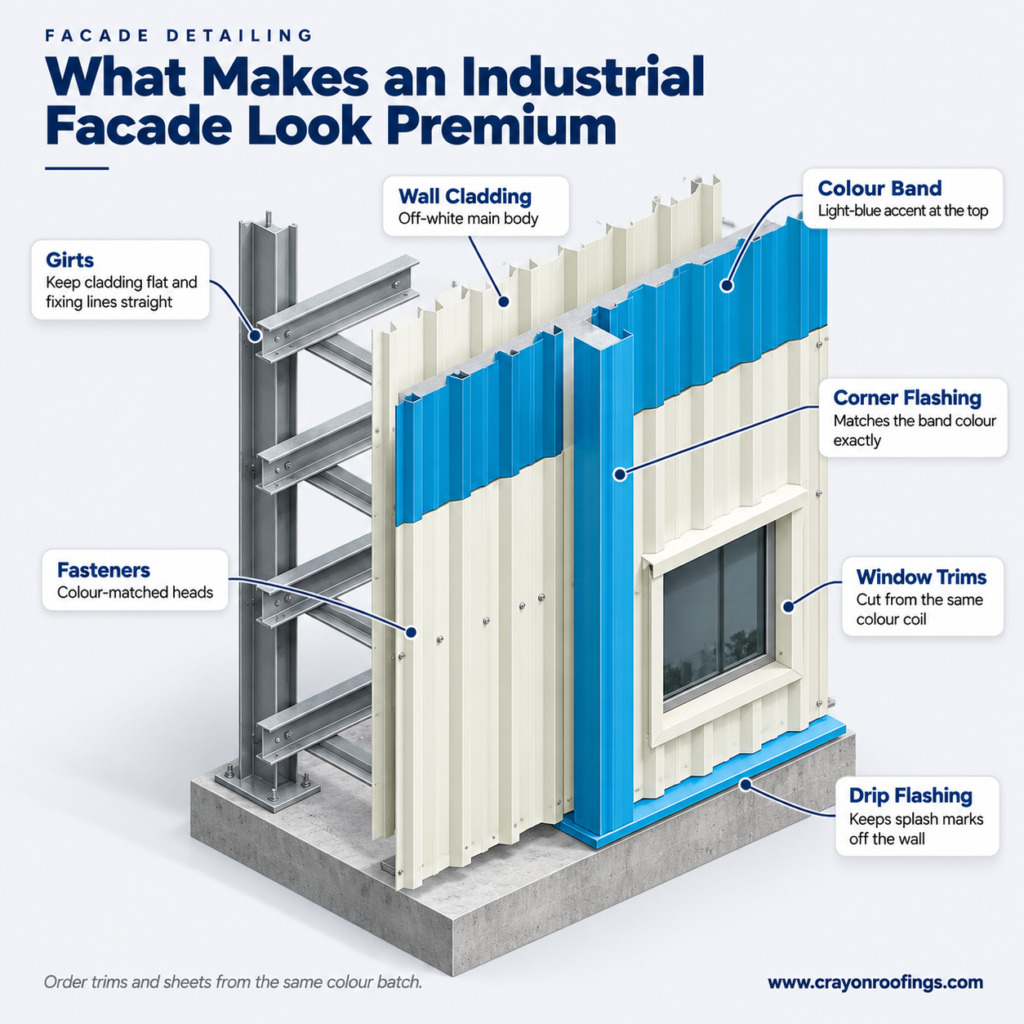
Wall cladding is supported on horizontal secondary members called girts, which are usually cold formed C or Z sections like roof purlins. Their spacing and alignment determine whether the cladding sits flat and whether fixing lines run straight across the elevation. In conventional steel sheds, hot rolled MS channels are also used as girts, and correctly sized members of either type help keep the facade true over long wall lengths
Details that most affect the finished look include:
- Corner flashings that match the wall colour exactly
- Window and door trims cut and folded from the same coil .
- Drip details at the base of the wall to keep splash marks off the cladding
- Fastener heads colour matched to the sheet where they are visible
Using trims from the same colour batch as the sheets avoids the slight shade differences that can show up clearly on a facade.
Integrating the Combination with a Pre-Engineered Building
Many industrial facades in Tamil Nadu are part of a pre-engineered building, where the frame, purlins, girts and cladding are designed together.
In these buildings, roof and wall panel layouts are fixed during structural design, including girt spacing, opening positions and band heights. The role of roof and wall panels within such structures is explained in Metfraa’s blog on how roof panels are used in pre-engineered buildings.
Involving the roofing distributor at the design stage makes it easier to coordinate colour bands with girt lines, plan trims around openings and confirm sheet lengths before fabrication begins.
Keeping JSW Indradhanush Colour Consistent Across Batches
Colour coated sheets, JSW Indradhanush included, can vary slightly in shade between production batches. On a single roof this is rarely visible, but on a large facade viewed in direct sunlight it can be noticeable.
Practical ways to manage this include:
- Ordering facade sheets and trims for one elevation from a single batch
- Recording the batch details for future extensions
- Planning phased projects so each visible elevation is completed from one supply
- Checking colour under daylight before installation, not only in the yard
For buildings planned in phases, it is worth agreeing at the outset how future extensions will be colour matched.
Maintenance and Colour Retention
Painted steel surfaces gradually change appearance over years of sun and rain. Fading and chalking are the most common signs, and the rate depends on the colour, the paint system and the exposure.
Simple maintenance helps a JSW Indradhanush combination keep its appearance:
- Periodic washing to remove dust, salt deposits and industrial residue
- Clearing debris from gutters and valleys
- Removing metal swarf after any later drilling or modification
- Inspecting cut edges, trims and fasteners for early signs of corrosion
Colour and paint system selection at the start has more influence on long-term appearance than maintenance alone.
Common Mistakes in Facade and Roofing Combinations
Several issues appear frequently on industrial projects:
- Choosing colours from a small sample without viewing them on a large surface
- Using the same sheet specification on every element regardless of exposure
- Sourcing trims and flashings separately from the sheets
- Mixing batches on a single visible elevation
- Selecting dark roof colours without considering heat gain
- Leaving girt alignment unchecked before cladding
- Planning the facade after the frame is already erected
Most of these are planning issues and can be resolved before the order is placed.
How Should You Plan a JSW Indradhanush Combination?
Step 1: Assess the exposure of each element Separate the roof, facade, bands and secondary structures by exposure level and distance from the coast.
Step 2: Fix the sheet specification for each element Decide where JSW Indradhanush is appropriate and where a higher coating specification is needed.
Step 3: Select the colour scheme Choose a main colour and an accent colour, keeping lighter shades for large roof areas.
Step 4: Choose roof and wall profiles Select profiles for span and appearance, and plan how roof and wall transitions will be detailed.
Step 5: Coordinate girts, trims and openings Align girt spacing, colour bands, flashings and door and window trims with the structural layout.
Step 6: Plan supply by batch and phase Order each visible elevation from a single batch and record details for future extensions.
Conclusion
JSW Indradhanush is being used in industrial facade and roofing combinations mainly for its broad colour range and cost efficiency, which make it well suited to coordinated building envelopes. Planned well, it allows roofs, walls, bands and trims to work together as one consistent design.
The most effective combinations treat each part of the envelope according to its exposure. Facades, bands and secondary structures often use Indradhanush, while highly exposed coastal roofs or buildings with corrosive processes may call for a heavier coating specification, with the colour scheme kept consistent across both.
Careful attention to girts, trims, batch consistency and early coordination with the structural design is what turns a set of coloured sheets into a facade that looks premium. As an authorized distributor of JSW colour coated sheets, Crayon Roofings & Structures also offers purlins and roofing accessories, and has experience supporting industrial projects where the roof and facade need to be specified together.
If you are planning an industrial facade and roofing combination and want to discuss where JSW Indradhanush fits in your building, contact us at Crayon Roofings & Structures to discuss your project requirements.
Frequently Asked Questions
1. Can I get JSW Indradhanush from Crayon Roofings & Structures for industrial facade and roofing projects?
Crayon Roofings & Structures is an authorized distributor of JSW colour coated sheets, including JSW Indradhanush, with matching trims for industrial facade and roofing combinations.
2. Can JSW Indradhanush be used for both roof and wall cladding?
Yes. The same colour coated sheet can be roll-formed into roof and wall profiles, giving a matching finish across the building.
3. Is JSW Indradhanush suitable for coastal industrial buildings?
Not necessarily. Highly exposed coastal roofs may need a heavier Al-Zn coating, while sheltered facade elements can often use Indradhanush.
4. Which factors should be considered when selecting JSW Indradhanush combinations?
Exposure, colour pairing, profile, thickness, trims, fastener compatibility and batch consistency should all be evaluated before finalising the combination.