
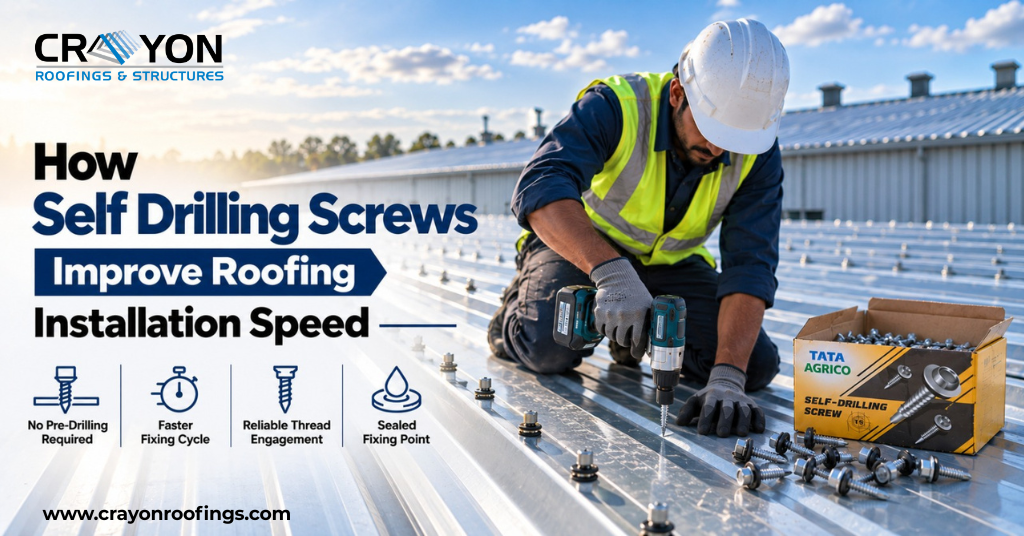
Self Drilling Screws play an important role in making roofing installation faster, simpler and more efficient. In industrial buildings, warehouses, factories and commercial structures, roofing involves numerous fixing points, where every sheet must be properly aligned and securely fastened. When this process is repeated across a large roof, even small-time savings at each fixing point can improve overall installation productivity.
Unlike conventional fastening methods that may require separate drilling before fixing, self-drilling screws are designed with a drill point that allows them to penetrate the material while being driven. This combines drilling and fastening into a single operation, reducing unnecessary steps and helping installers maintain a smoother workflow.
For roofing contractors, this can simplify sheet-to-purlin fixing, reduce repetitive tool handling and support consistent installation. Crayon Roofings & Structures, an authorised distributor of Tata Agrico screws in Tamil Nadu and Puducherry, supplies Tata Agrico self-drilling screws for suitable roofing and construction applications. Selecting the right fastener for the roofing sheet and supporting structure can help reduce installation difficulties, rework and avoidable delays.
Why Roofing Installation Speed Matters
Roofing projects involve many interconnected activities. Sheets need to be lifted, positioned, aligned and fixed while the installation team works around purlins, structural members and site access conditions.
Self Drilling Screws help roofing installers complete repetitive fixing operations with fewer separate steps, making them suitable for projects where installation efficiency is important.
The fastening process may appear to be a small part of the overall project, but it is repeated throughout the roof. If every fixing takes additional time, the cumulative effect can become significant on larger projects.
Slow fastening operations can contribute to:
- Longer installation schedules
- Increased labour hours
- More repetitive movements
- Additional tool handling
- Delays in completing roofing sections
- Higher chances of installation interruptions
- Rework caused by incorrect or damaged fixings
Improving the efficiency of each fixing operation can therefore contribute to smoother project execution.
Using Self Drilling Screws can help simplify one of the most repetitive tasks in the roofing installation process.
How Self Drilling Screws Simplify Roofing Installation
With conventional fastening methods, the installer may need to drill a hole first and then insert and tighten the fastener. This creates separate stages within a task that must be repeated across the roof.
Self-drilling screws are designed to reduce this sequence. Their drill point penetrates the material as the screw is driven, allowing the installer to drill and fasten in one continuous operation.
This can reduce the number of actions required at each fixing point. Instead of repeatedly switching between separate drilling and fastening operations, the installer can use a suitable power tool to complete the fixing directly.
On large roofing projects, this simplified process can help maintain a more consistent installation rhythm.
Faster Sheet-to-Purlin Fixing
One of the most common applications of Self Drilling Screws is fixing roofing sheets to steel purlins.
The installer needs to maintain the position of the sheet while securing it to the supporting structure. Once the sheet is correctly aligned, the fastener must penetrate both the roofing material and the supporting member.
Using suitable Self Drilling Screws allows this operation to be completed without a separate pilot-drilling stage.
When the same process is repeated across a large warehouse or factory roof, the time saved at individual fixing points can contribute to improved overall productivity.
Reducing Repetitive Tool Handling
Roofing installation often takes place at height, making unnecessary movement and repeated tool changes undesirable.
When separate drilling and fastening operations are required, installers may need to perform additional movements or switch between tools. These repeated actions may appear insignificant individually, but they can add up over an entire project.
For large roofing areas, Self Drilling Screws can help reduce repeated drilling and fastening movements during installation.
This makes Self Drilling Screws particularly useful for repetitive roofing applications where multiple fixing points need to be completed efficiently.
This helps create a more straightforward sequence:
Position the sheet → Place the screw → Drill and fasten → Check the fixing
A simpler sequence can make repetitive roofing work easier to manage.
Where Self Drilling Screws Can Make the Biggest Difference
The productivity advantage of Self Drilling Screws can become more noticeable in applications involving large roof areas and high numbers of fixing points.
Industrial Warehouses
Large warehouse roofs often contain extensive runs of roofing sheets fixed at numerous points. A streamlined fastening process can help installation teams progress more consistently.When specified correctly, Self Drilling Screws can support a more continuous fixing process across extensive warehouse roofing areas.
Factory Buildings
Factory roofing projects may involve large roof spans and multiple supporting purlins. Appropriate self-drilling screws can simplify repetitive sheet fixing.
Commercial Buildings
Commercial projects often have strict construction schedules. Efficient fastening can help roofing teams complete their assigned installation work without unnecessary delays.
During re-roofing, site access and working conditions can sometimes make installation more challenging. Using appropriate fasteners can help simplify the fixing process while reducing unnecessary installation steps.
Speed Should Not Come at the Cost of Fixing Quality
Installation speed is valuable, but it should never replace correct fastening practice.
A screw that is driven too aggressively can damage the roofing sheet or sealing washer. On the other hand, insufficient tightening can affect the quality of the fixing.
Installers should therefore focus on achieving consistent and correct fastening rather than simply driving screws as quickly as possible.
The installation tool should also be suitable for the selected fastener, and the screw should be driven according to the manufacturer’s recommended application requirements.
Selecting the Right Self Drilling Screw
The right fastener can make a significant difference to both installation efficiency and fixing performance. Several factors should be considered before selecting Self Drilling Screws for a roofing application.
Roofing Sheet Thickness
The thickness of the roofing sheet influences the type of drill point and screw specification required. The fastener should be capable of penetrating the material efficiently without causing unnecessary deformation.
Supporting Steel Thickness
The supporting purlin or steel member also needs to be considered. The screw must have suitable drilling capacity for the material it is expected to penetrate. For projects requiring reliable structural steel and supporting steel materials, proper material selection can also help ensure compatibility during roofing installation.
Screw Length
The screw should provide suitable engagement with the supporting material while remaining appropriate for the roofing assembly.
Corrosion Protection
Roofing fasteners are exposed to environmental conditions over their service life. Suitable corrosion protection is therefore important when selecting screws for roofing applications.
Sealing Washer
The washer helps protect the fixing point and support sealing around the screw. It should be seated correctly against the roofing sheet without excessive compression.
How Correct Fastener Selection Helps Avoid Delays
Selecting suitable Self Drilling Screws at the beginning of the project can help minimise fastening-related interruptions during installation.
For example, if the drill point is not appropriate for the supporting steel, the installer may need additional effort or a separate drilling operation. If the screw length is incorrect, the fixing may need to be removed and replaced.
Similarly, damaged washers or over-tightened screws can result in rework.
Selecting the appropriate self-drilling screw before work begins can therefore help reduce avoidable interruptions and keep the installation process moving.
Common Mistakes That Reduce Installation Efficiency
Even a high-quality self-drilling screw cannot deliver its intended benefit if it is incorrectly selected or installed.
Some common mistakes include:
- Using an unsuitable screw length
- Choosing the wrong drill-point capacity
- Selecting a fastener that does not match the supporting steel
- Applying excessive pressure during drilling
- Over-tightening the screw
- Damaging the sealing washer
- Using unsuitable installation tools
- Ignoring the thickness of the supporting member
These issues can lead to damaged sheets, poor sealing, rework and unnecessary labour time.
Self Drilling Screws and Large-Scale Roofing Productivity
The real advantage of self-drilling screws becomes clearer when the number of fixing points increases.
Consider a large industrial roof requiring several thousand individual fixings. If each fixing requires separate drilling and fastening, the additional movements can consume considerable installation time.
With an appropriate self-drilling screw, the drilling and fastening process can be combined. This allows installers to move from one fixing point to the next with fewer interruptions.
Of course, overall project duration also depends on roof design, manpower, weather, material handling, site access and installation planning. Self-drilling screws are not the only factor that determines project speed, but they can remove unnecessary steps from one of the most repetitive roofing activities.
Why Tata Agrico Self Drilling Screws Can Be Considered for Roofing Applications
Fastener quality and specification are important when roofing sheets are being installed across large areas. Tata Agrico Self Drilling Screws are designed for applications where drilling and fastening need to be performed efficiently.
For contractors, selecting a suitable branded fastening solution can help simplify procurement while providing a clearly specified product for the intended application.
The important point is to match the screw specification with the roofing sheet, supporting steel and installation requirement rather than selecting a fastener based only on appearance or price.
Roofing & Fastening Solutions for Efficient Installation
Choosing the right roofing materials is only one part of a successful roofing project. The fixing system also plays an important role in installation efficiency, durability and overall project execution
Crayon Roofings & Structures is an authorised distributor of Tata Agrico screws in Tamil Nadu and Puducherry, offering Tata Agrico self-drilling screws for suitable roofing and construction applications. Selecting the right fastener for the roofing sheet and supporting structure can help reduce installation difficulties, rework and avoidable delays.
Along with fastening solutions, Crayon Roofings & Structures also provides JSW colour-coated roofing sheets, C & Z purlins and polycarbonate sheets, helping contractors, fabricators and project teams source compatible roofing products for different project requirements.
Having roofing sheets, structural support products and suitable fastening solutions available through one supplier can simplify procurement and help project teams maintain a more consistent installation process.
Conclusion
Self Drilling Screws can make roofing installation more efficient by combining drilling and fastening into a single operation.. This reduces unnecessary installation steps, limits repetitive tool handling and helps roofing teams maintain a smoother workflow across large roofing areas.
The benefit becomes particularly relevant in warehouses, factories, commercial buildings and other projects where thousands of fixing points may be involved. However, installation speed should always work together with correct screw selection, proper tool use and appropriate fastening technique.
Choosing the right fastener for the roofing sheet and supporting structure can help reduce avoidable installation difficulties and rework. With suitable products such as Tata Agrico self-drilling screws, supplied by Crayon Roofings & Structures, contractors can approach roofing installation with a more organised and efficient fastening process.
Frequently Asked Questions
1. How do Self Drilling Screws improve roofing installation speed?
Self-drilling screws combine drilling and fastening into one operation, reducing separate installation steps and helping installers complete repetitive roofing fixings more efficiently.
2. Can self-drilling screws be used for industrial roofing?
Suitable self-drilling screws can be used for industrial roofing when the screw specification matches the roofing sheet and supporting steel.
3. What factors should be checked before selecting self-drilling screws?
Roofing sheet thickness, supporting steel thickness, screw length, drill-point capacity, corrosion protection and sealing washer requirements should be considered.
4. Can Self Drilling Screws reduce roofing labour requirements?
They can reduce repetitive installation steps and improve workflow efficiency, although actual labour requirements depend on project size, design, site conditions and installation methods.
5. Does Crayon Roofings supply self-drilling screws?
Crayon Roofings & Structures supplies Tata Agrico self-drilling screws for suitable roofing and construction applications in Tamil Nadu and Puducherry.