
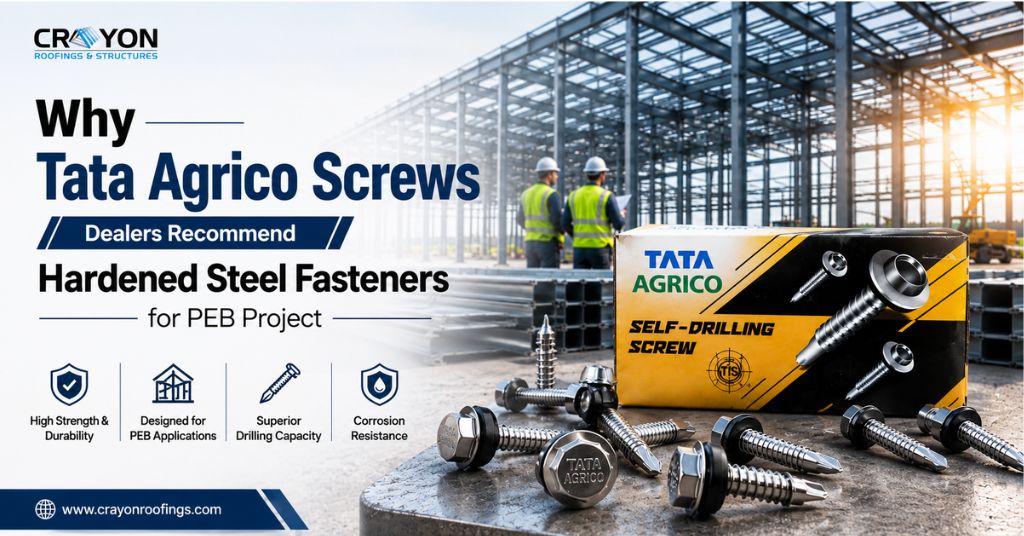
PEB projects depend on thousands of individual connections working together to maintain the strength, stability, and durability of the building. While primary and secondary steel members receive significant attention during design, the fasteners used for roofing, cladding, and steel connections are equally important.
This is why Tata Agrico Screws Dealers often recommend hardened steel fastened for Pre-Engineered Building projects. A properly engineered fastener must withstand drilling forces, provide reliable thread engagement, maintain clamping pressure, and perform under changing environmental and structural conditions.
Tata Agrico Screws Dealers can help contractors and procurement teams identify suitable fasteners based on the project’s roofing application, steel thickness, environmental conditions, and installation requirements.
For contractors and roofing professionals in Chennai, Crayon Roofings & Structures supplies Tata Agrico Screws as an authorized distributor, making the product relevant to projects where reliable roofing fasteners are required.
The contractors and procurement teams, Tata Agrico Screws Dealers can help identify suitable fasteners based on project requirements, roofing applications, and installation conditions.
What Are Hardened Steel Fasteners?
Hardened steel fasteners are manufactured through controlled heat-treatment processes that increase the hardness and mechanical strength of the steel.
The objective is to achieve a suitable balance between:
- Hardness
- Tensile strength
- Toughness
- Drilling performance
- Thread-forming capability
- Resistance to deformation
In self-drilling roofing applications, the screw must be hard enough for its drill point to penetrate the steel substrate without excessive wear or deformation.
However, hardness alone does not determine fastener quality. A properly manufactured fastener requires an appropriate combination of material properties, geometry, heat treatment, coating, and dimensional accuracy.
Why Fasteners Matter in PEB Construction
A typical PEB consists of primary frames, secondary structural members, roof panels, wall cladding, insulation systems, flashing, gutters, and other components.
Fasteners are responsible for connecting several of these elements.
They may be used for:
- Roofing sheet-to-purlin connections
- Side-lap connections between sheets
- Wall cladding installation
- Flashing and trim installation
- Secondary steel connections
- Insulated panel fixing
- Accessory installation
Properly engineered structural members cannot deliver their intended performance if inadequate fasteners weaken critical connections within the building envelope.
For example, an unsuitable roofing screw can result in poor penetration, inadequate clamping, damaged washers, loose sheets, or water leakage.
Working with experienced Tata Agrico Screws Dealers can make this selection process easier by helping project teams understand the appropriate fastener requirements for different PEB applications.
Experienced Tata Agrico Screws Dealers can also help contractors understand the appropriate fastener specifications for different PEB roofing applications.
Because fasteners work together with roofing sheets, purlins and other accessories, sourcing them through a roofing-focused supplier such as Crayon Roofings & Structures can help contractors coordinate related roofing requirements. We, Crayon also supplies Metal Roofing Sheets, C and Z purlins for industrial roofing applications.
Why Hardened Steel Is Important for Self-Drilling Fasteners
One of the biggest advantages of hardened steel is its ability to withstand the drilling and fastening process.
A self-drilling screw typically performs several operations in one installation:
- Penetrate the steel sheet or purlin.
- Creates the required hole.
- Forms or engages in the thread.
- Clamps the roofing material against the supporting member.
- Creates a sealed connection through the washer.
If the screw material is too soft, the drill point may become damaged or deform during installation.
This can result in:
- Slow drilling
- Excessive installation torque
- Poor thread formation
- Screw breakage
- Inconsistent fastening
A properly engineered hardened steel fastener provides the necessary mechanical performance for efficient installation.
1. Better Drilling Performance
PEB roofing systems frequently involve fastening metal sheets to steel purlins.
The screw must penetrate the substrate quickly while maintaining its drill-point geometry.
Hardened steel helps the drilling tip maintain its shape during installation, allowing:
- Faster penetration
- More consistent drilling
- Reduced installation effort
- Better productivity
- Lower risk of damaged fasteners
For large industrial roofing projects involving thousands of fasteners, even small differences in installation efficiency can have a noticeable impact on project productivity.
2. Higher Resistance to Fastener Deformation
During installation, roofing screws experience torque and axial forces.
If the fastener material deforms excessively, the head, threads, or drill point can become damaged.
Hardened steel helps maintain the fastener’s geometry under installation loads.
This is particularly important when power tools are used for high-volume roofing installation.
However, the screw must still be installed using the correct driver setting. Excessive torque can damage even a high-quality fastener.
3. Reliable Thread Engagement
The threads of a self-drilling screw must engage securely with the supporting steel.
Proper thread engagement helps establish a reliable mechanical connection between the roofing sheet and purlin.
A high-quality fastener should provide:
- Consistent thread geometry
- Accurate dimensions
- Reliable engagement
- Adequate clamping force
Poor thread formation can reduce connection reliability and may contribute to movement or loosening over time.
4. Better Resistance to Installation Stress
Fasteners experience significant mechanical stress during installation.
The drill point penetrates the steel while the threaded portion advances into the substrate. At the same time, the screw head applies clamping pressure to the roofing sheet and washer.
A properly hardened fastener is better equipped to withstand these installation forces without premature failure.
This becomes particularly important in PEB projects where installation is performed continuously across large roof areas.
5. Improved Roofing Connection Reliability
The purpose of a roofing fastener is not simply to hold the sheet in position.
It must maintain a secure connection throughout the service life of the roofing system.
A reliable fastening system helps resist forces caused by:
- Wind uplift
- Thermal expansion and contraction
- Building vibration
- Rain and weather exposure
- Maintenance activity
The exact fastener requirements depend on the structural design, roofing profile, substrate, wind conditions, and manufacturer specifications.
Hardened Steel and Corrosion Protection Must Work Together
Hardness provides mechanical performance, but it does not automatically provide corrosion resistance.
This distinction is extremely important.
A roofing fastener used in an industrial or coastal environment must have both:
Mechanical performance + appropriate corrosion protection
Depending on the application, fasteners may use protective coatings designed to reduce corrosion and extend service life.
For PEB projects in humid or coastal regions, procurement teams should evaluate:
- Coating type
- Coating consistency
- Environmental exposure
- Compatibility with roofing material
- Washer durability
- Expected service conditions
A strong screw that corrodes prematurely is not a successful roofing fastener.
Why the Washer Is Just as Important as the Screw
In roofing applications, the screw and washer function as a system.
Many roofing screws use an EPDM or similar sealing washer beneath the head.
The washer helps:
- Seal the penetration point
- Prevent water ingress
- Distribute clamping pressure
- Protect the roofing surface
If the screw is high quality but the washer is poor, the connection can still become a potential leakage point.
Therefore, Tata Agrico Screws Dealers and experienced roofing professionals typically consider the complete fastener assembly rather than evaluating the screw body alone.
Why Fastener Quality Matters in Chennai’s Climate
PEB structures located in Chennai and other coastal regions face a combination of high temperatures, humidity, monsoon rainfall, and salt-laden atmospheric conditions.
These environmental factors make corrosion protection particularly important.
Roofing fasteners can be exposed to:
- Moisture
- Condensation
- Rainwater
- Atmospheric pollutants
- Coastal salt exposure
- Temperature cycling
A suitable fastener specification should therefore consider the actual environmental conditions of the project.
For coastal industrial buildings, choosing an appropriately protected fastener can help reduce premature corrosion and maintenance requirements.
How Hardened Fasteners Support Faster PEB Installation
One of the main advantages of PEB construction is faster project execution.
Roofing installation is a major component of the construction schedule, particularly for large warehouses and industrial facilities.
Self-drilling hardened steel fasteners can support installation productivity by eliminating the need for separate pre-drilling in suitable applications.
This can reduce:
- Drilling operations
- Tool changes
- Installation steps
- Labor requirements
- Overall fastening time
When thousands of fasteners are required, installation efficiency becomes an important project consideration.
Common Problems Caused by Poor-Quality Fasteners
Using low-quality or unsuitable fasteners can create several problems during and after construction.
1. Drill Point Failure
A poorly manufactured drill point may wear or deform before completing penetration.
2. Head Damage
Excessive torque or inadequate material strength can damage the screw head.
3. Thread Stripping
Poor thread geometry or unsuitable hardness can reduce thread engagement.
4. Washer Damage
Over-driving the fastener can crush or damage the sealing washer.
5. Corrosion
Inadequate protective coating can result in premature rusting.
6. Roofing Leakage
Damaged washers, loose fasteners, or incorrect installation can create leakage points.
7. Sheet Damage
Excessive installation torque can deform the roofing sheet around the fastener.
These problems can increase maintenance requirements and affect the long-term performance of the building envelope.
How Engineers and Contractors Should Select PEB Fasteners
Consulting Tata Agrico Screws Dealers before procurement can help contractors evaluate fastener specifications, application suitability, and installation requirements before placing bulk orders.
Consider the following factors.
Steel Thickness
The fastener must be suitable for the thickness and type of steel penetrated.
Purlin Thickness
The supporting purlin determines the required drilling and thread engagement characteristics.
Roofing Profile
Different roofing profiles may require different fastener lengths and washer arrangements.
Environmental Exposure
Coastal, humid, chemical, and industrial environments may require enhanced corrosion protection.
Wind Load
Roof fastener spacing and connection requirements should be determined according to the project’s structural design and applicable standards.
Washer Specification
The washer should be compatible with the roofing material and environmental conditions.
Installation Equipment
Power tools should be operated at suitable torque and speed settings to avoid over-driving or under-driving.
Consulting Tata Agrico Screws Dealers before bulk procurement can help project teams evaluate product specifications, quantities, and application suitability.
Why Contractors Prefer Reliable Tata Agrico Fasteners
For industrial roofing and PEB applications, contractors generally look for fasteners that deliver consistent installation performance across thousands of connections.
This is one reason branded products supplied through established Tata Agrico Screws Dealers can be attractive for professional projects.
The focus is not merely on the brand name. Contractors need consistency in:
- Dimensions
- Drill-point geometry
- Thread quality
- Material performance
- Coating
- Washer quality
- Packaging
- Batch consistency
Consistent fastener quality helps reduce installation variability and makes large-scale roofing work easier to manage.
What Should Procurement Teams Ask Tata Agrico Screws Dealers?
Before placing a bulk order, procurement teams should clarify several technical details with Tata Agrico Screws Dealers to ensure that the selected fasteners match the project’s requirements.
Ask about:
- Fastener diameter
- Fastener length
- Compatible steel thickness
- Drill-point specification
- Material and hardness
- Coating system
- Washer material
- Application suitability
- Recommended installation method
- Available pack sizes
- Product documentation
For large PEB projects, purchasing based solely on price can create higher costs later through installation delays, replacements, leakage, and maintenance.
Are Hardened Steel Fasteners Suitable for Every PEB Application?
Different PEB components have different fastening requirements. A roofing sheet connection, side-lap connection, structural steel connection, and insulated panel connection may require different fastener designs.
Engineers should evaluate:
- Substrate material
- Thickness
- Connection type
- Load requirements
- Environmental exposure
- Required corrosion protection
- Installation method
The correct fastener is therefore the one that matches the complete application.
The Role of Tata Agrico Screws Dealers in PEB Procurement
A knowledgeable dealer can provide more than product availability.
For contractors and project procurement teams, an experienced supplier can help identify suitable fastener specifications based on:
- Roofing application
- Steel thickness
- Project scale
- Environmental conditions
- Installation requirements
- Quantity requirements
This can simplify procurement and reduce the risk of selecting an unsuitable product for the project.
For large warehouses, factories, logistics centers, and PEB facilities, technical product selection should ideally happen before roofing installation begins.
Conclusion
Fasteners may be small components, but they play a critical role in the performance of a PEB roofing system. Hardened steel fasteners are preferred for many self-drilling applications because they can provide the mechanical strength and drilling performance required for efficient installation.
For contractors and project procurement teams, working with reliable Tata Agrico Screws Dealers can make it easier to identify fasteners suited to the specific requirements of PEB roofing, warehouses, factories, and industrial steel buildings.Reliable Tata Agrico Screws Dealers can also support customers with product information and guidance when selecting fasteners for different roofing and PEB applications.
The right fastener specification, combined with correct installation practices and appropriate corrosion protection, can help deliver a more reliable, durable, and efficient roofing system. For expert guidance on selecting suitable fastening solutions, get in touch with Crayon Roofings & Structures.
Frequently Asked Questions
1. Why does fastener hardness matter in PEB roofing?
Fastener hardness affects drilling performance, thread formation, and resistance to deformation during installation. A properly specified hardened steel fastener can provide more consistent performance when fixing roofing sheets to steel purlins.
2. Can the wrong roofing screw affect the life of a PEB roof?
An unsuitable fastener can lead to poor penetration, damaged threads, washer failure, corrosion, or loosening. Over time, these issues can contribute to leakage and increased roof maintenance.
3. Crayon Roofings & Structure provides Tata Agrico screws?
Tata Agrico Screws Dealers such as Crayon Roofings & Structure can provide Tata Agrico screws for roofing and structural applications, helping customers choose suitable fastening solutions for their projects.
4. How can Crayon Roofings & Structure help with Tata Agrico screws?
Crayon Roofings & Structure can assist customers in selecting the right Tata Agrico screws based on roofing requirements, application, and project needs.