
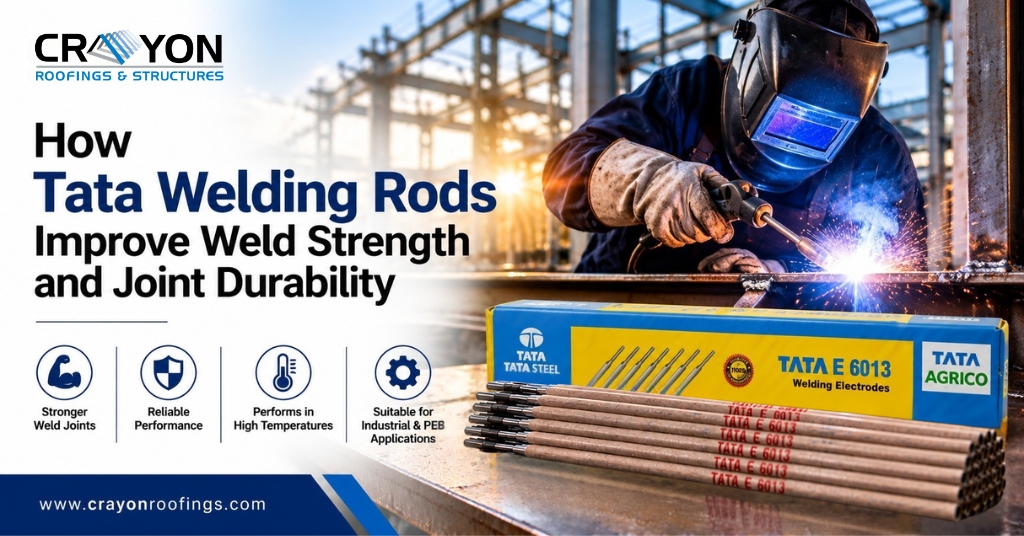
Tata Welding Rods are an important part of the welding process when fabricated steel components need dependable and durable joints. For projects where consistent welding performance matters, Crayon Roofings & Structures brings Tata welding electrodes into its range of industrial and fabrication products. In structural fabrication, the quality of a weld can influence how effectively two metal components transfer loads and withstand working conditions over time. A strong-looking weld alone is not enough; the connection must be produced with the right consumable, welding procedure and application technique.0
For fabricators working with structural steel, industrial equipment, PEB components and general steel assemblies, selecting an appropriate welding electrode can help maintain consistency from one joint to another. The right consumable also makes it easier for welders to control the arc, deposit filler metal evenly and produce a joint that meets the required specification.
What Makes a Welded Joint Strong?
A welded joint becomes strong when the deposited weld metal forms a proper connection with the base materials.
Several factors influence the result, including:
- Base metal composition
- Electrode classification
- Joint preparation
- Welding current
- Travel speed
- Electrode angle
- Heat input
- Welder skill
- Surface cleanliness
- Storage and handling of electrodes
If any of these factors are poorly controlled, the resulting joint may not perform as expected.
This is why electrode selection should be considered alongside the welding procedure rather than treated as a separate purchasing decision. Tata Welding Rods can be considered for suitable structural Steel fabrication applications where repeated joints require consistent welding performance.
How the Welding Electrode Affects the Joint
The electrode supplies the filler metal required to form the weld. Its coating also influences arc characteristics, slag formation and the overall behaviour of the welding operation.
A suitable Tata Welding Rods selection can help the welder achieve controlled metal deposition and a more consistent welding process when used under the recommended conditions.
This becomes particularly important when a fabrication shop is producing many similar joints. Consistency across repeated welds can reduce variations in workmanship and make quality inspection more predictable.
Stable Arc Behaviour Supports Better Control
Arc stability is an important part of producing a controlled weld.
When the arc behaves consistently, the welder can maintain the molten pool more effectively and control the movement of the electrode across the joint.
In PEB fabrication, consistent arc behaviour is particularly useful when welding structural steel components and connections that require controlled and repeatable welds.
This can help with:
- Bead formation
- Fusion
- Deposition control
- Slag handling
- Overall weld appearance
However, arc behaviour also depends on the welding machine, current settings, electrode condition and operator technique. The consumable is only one part of the complete welding system.
Consistent Metal Deposition Matters
A welded joint is built layer by layer as filler metal is deposited into the prepared joint.
Uneven deposition can make it more difficult to achieve the required bead profile and may increase the need for corrective work.
With an appropriate Tata Welding Rods product selected for the application, welders can work toward consistent deposition while following the specified welding parameters.
For repetitive structural fabrication, this consistency can be valuable because the same welding procedure can be applied across multiple similar joints.
Joint Preparation Cannot Be Ignored
Even the right electrode cannot compensate for poor joint preparation.
Before welding begins, the joint area should be properly prepared and free from contaminants that could interfere with fusion.
Depending on the application, preparation may include:
- Removing rust
- Cleaning oil and grease
- Removing paint from the weld area where required
- Preparing the correct joint geometry
- Ensuring proper fit-up
- Maintaining the specified root gap
Good preparation gives the weld metal a better opportunity to fuse correctly with the base material. When using Tata Welding Rods, proper joint preparation remains equally important for achieving the intended welding result.
How Weld Defects Affect Durability
A joint may fail prematurely when defects are introduced during welding.
Some common welding defects include:
Porosity
Gas pockets within the weld can reduce the effective integrity of the deposited metal.
Slag Inclusion
Foreign material trapped between weld passes can create discontinuities within the joint.
Lack of Fusion
Insufficient bonding between the weld metal and base material can reduce joint performance.
Undercutting
Incorrect welding parameters or technique can create grooves along the edge of the weld.
Cracking
Cracks are particularly serious because they can propagate when the joint is subjected to stress.
Preventing such defects requires proper material preparation, suitable consumables, controlled welding parameters and competent workmanship.
Electrode Storage Has a Direct Role
The condition of the electrode at the time of welding can affect the welding process.
Moisture, contamination and improper storage can alter the behaviour of certain electrode types. For applications where moisture control is important, electrodes should be stored and handled according to the manufacturer’s instructions.
Fabrication teams should pay attention to:
- Storage temperature
- Humidity exposure
- Packaging condition
- Handling practices
- Recommended holding conditions
- Reconditioning requirements, where applicable
Proper storage helps ensure that the consumable is used in the condition intended by the manufacturer.
Matching the Electrode to the Base Metal
One of the most important decisions in welding is choosing a consumable that matches the material being joined.
Before ordering Tata Welding Rods, fabricators should review:
Base metal → Material thickness → Joint design → Welding position → Required strength → Applicable specification
The electrode classification should be compatible with the base material and the required mechanical properties of the finished joint.
For structural applications, the approved drawing, welding procedure specification and applicable standards should take priority over a general-purpose selection.
Why Welding Procedure Matters
A welding electrode cannot be evaluated independently from the process in which it is used.
Current, polarity, travel speed, electrode angle and heat input all influence the final weld.
For example, using excessive current may increase heat input and affect the surrounding material, while unsuitable travel speed can influence penetration and bead geometry.
A documented welding procedure gives the fabrication team a controlled method to follow and helps different welders achieve more consistent results.
Durability Under Real Working Conditions
Industrial welded joints may be exposed to more than static loads.
Depending on the application, a fabricated assembly may experience:
- Repeated loading
- Equipment vibration
- Impact
- Temperature variation
- Outdoor exposure
- Handling stresses
- Operational movement
The welding system should therefore be selected based on the actual service conditions of the component.
A joint designed for a lightly loaded fabrication may have very different requirements from a structural connection carrying significant operational loads.
Tata Welding Rods for Structural and Industrial Fabrication
In structural and industrial fabrication, welding consumables are selected according to the material, joint requirements and applicable welding procedure.
Tata Welding Rods can be used across suitable fabrication applications where consistent weld deposition and dependable welding performance are required.
Typical applications may include:
- Structural steel fabrication
- PEB components
- Industrial sheds
- Steel frames
- Fabricated machinery
- General engineering components
- Maintenance and repair work
The specific electrode grade or classification should always be confirmed against the project specification before welding begins.
How Better Welding Can Reduce Rework
Rework consumes more than welding consumables.
When a joint fails inspection, the fabrication team may need to grind the weld, prepare the area again, reweld the connection and repeat inspection.
This can affect:
- Production schedules
- Labour utilization
- Material consumption
- Inspection time
- Delivery commitments
Using Tata Welding Rods appropriate to the application, together with controlled welding procedures, can help fabrication teams work toward consistent results and reduce avoidable corrective work.
The objective is not simply to complete the weld quickly but to produce the joint correctly the first time.
Welder Skill Still Makes the Difference
Consumable quality is important, but the person performing the weld remains a critical part of the process.
A trained welder needs to understand how to control:
- Arc length
- Electrode movement
- Travel speed
- Welding angle
- Current settings
- Interpass cleaning
- Heat input
The same electrode can produce different results when used with different techniques.
This is why good fabrication practices combine a suitable consumable with trained personnel, properly maintained equipment and an approved welding procedure.
Choosing the Right Welding Consumable
For a fabrication project, the selection process should begin with the application rather than the brand name alone.
Ask:
What material are we welding?
What joint strength is required?
What welding position will be used?
What does the project specification require?
What welding procedure is approved?
Once these factors are established, the appropriate Tata Welding Rods product or electrode classification can be selected according to the application.
This approach helps ensure that the consumable supports the engineering requirements of the finished structure.
Crayon Roofings & Structures for Tata Welding Electrodes
For fabrication and industrial requirements, sourcing welding consumables from a reliable supplier can simplify procurement and help maintain consistency across projects.
Crayon Roofings & Structures supplies Tata Welding Rods for suitable industrial and fabrication applications across Tamil Nadu and Pondicherry.
The right electrode can support weld quality, but final joint performance still depends on correct material preparation, welding parameters, electrode handling and operator skill.
Strong Welds Begin Before the Arc Is Struck
A durable welded joint is the result of several controlled steps rather than one individual factor.
It begins with selecting the appropriate consumable and continues through joint preparation, equipment setup, welding execution, interphases cleaning and final inspection.
Using Tata Welding Rods as part of a properly controlled welding process can help fabricators work toward consistent and dependable joints.
For projects where structural reliability matters, this approach is more valuable than simply choosing a consumable based on cost.
Conclusion
Weld strength and joint durability depend on the interaction between the base material, welding consumable, equipment, procedure and operator.
Tata Welding Rods can support consistent weld deposition and reliable joint formation when the appropriate electrode is selected for the application and used according to the required welding procedure.
For structural steel and industrial fabrication, proper preparation, controlled welding parameters and correct electrode storage are equally important.
A well-executed welding process does more than connect two pieces of steel. It creates a joint that needs to perform reliably throughout the intended service life of the fabricated component.
Crayon Roofings & Structures is an authorised distributor for Tata welding electrodes, serving industrial and fabrication requirements across Tamil Nadu and Pondicherry.
Frequently Asked Questions
1. How do Tata Welding Rods improve weld strength?
They support controlled weld deposition and consistent arc performance when the correct electrode is matched to the material and welding procedure.
2. Can welding electrodes affect joint durability?
Yes. Electrode selection, storage, welding parameters and application technique can all influence the quality and long-term performance of a welded joint.
3. How Can Crayon Help with Better Welding Results?
Crayon Roofings & Structures provides suitable Tata welding electrodes for industrial fabrication, helping customers choose the right consumable for their welding requirements.
4. How should welding electrodes be stored?
They should be kept in suitable conditions and handled according to the manufacturer’s storage recommendations to protect their intended welding characteristics.