
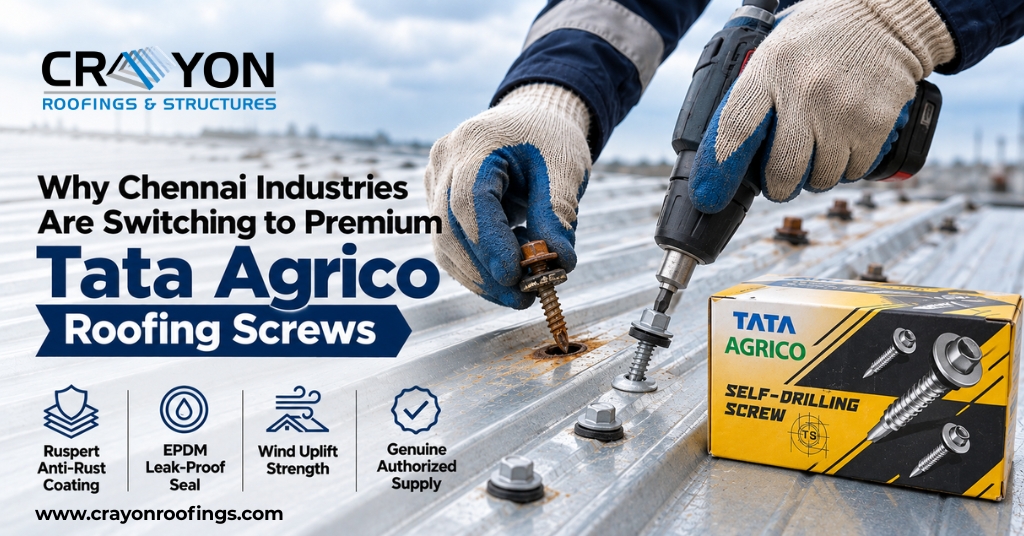
Tata Agrico Roofing screws are being specified more often on factory and warehouse roofs across Chennai, and the change is being driven less by brand preference than by experience on site. Plant owners and facility managers who have dealt with rusted fastener heads, leaking fixings during the northeast monsoon and early re-roofing work are revisiting a component that was once chosen almost entirely on price.
A roofing screw is one of the smallest items on a project bill of materials. It is also the component that holds the sheet down in a cyclone, seals every penetration against rain and is often the first part of the roof to show corrosion.
That combination is why many Chennai industries now treat the fastener as a specification decision rather than a commodity purchase.
As an authorized Tata Agrico distributor covering self drilling screws, welding electrodes and grinding wheels, Crayon Roofings & Structures works with industrial buyers who need the right fixing for each roof. The company is also an authorized distributor of JSW colour coated sheets and runs a JSW Experience Centre at its facility. For a plant owner, the brand on the packet matters less than whether the screw suits that building’s sheet, purlin and exposure.
So, what is pushing Chennai’s industrial buyers towards premium roofing screws, and what should they check before switching?
What Sets Tata Agrico Roofing Screws Apart from Commodity Fasteners?
Tata Agrico Roofing Screws is the hand tools and implements brand of Tata Steel, and its self drilling screws are designed specifically for metal roofing and cladding.
Based on published product listings, the roofing range typically features:
- A hardened drill point that forms its own hole in the purlin
- A hex flange head for controlled driving
- An EPDM washer to seal the fixing point
- A grey Ruspert coating built up in three layers: zinc, a chemical film and a rustproof topcoat
- Salt spray performance stated at around 1,000 hours in product listings
- Single thread and double thread variants for different fixing needs
Commodity fasteners may look similar in the packet, but often differ in steel quality, heat treatment, coating thickness and washer material. A detailed comparison is covered in our blog on what makes Tata Agrico screws different from ordinary fasteners.
This blog looks at the question from a different angle: the conditions in Chennai that are making the difference matter.
Coastal Corrosion Is Reaching the Fastener First
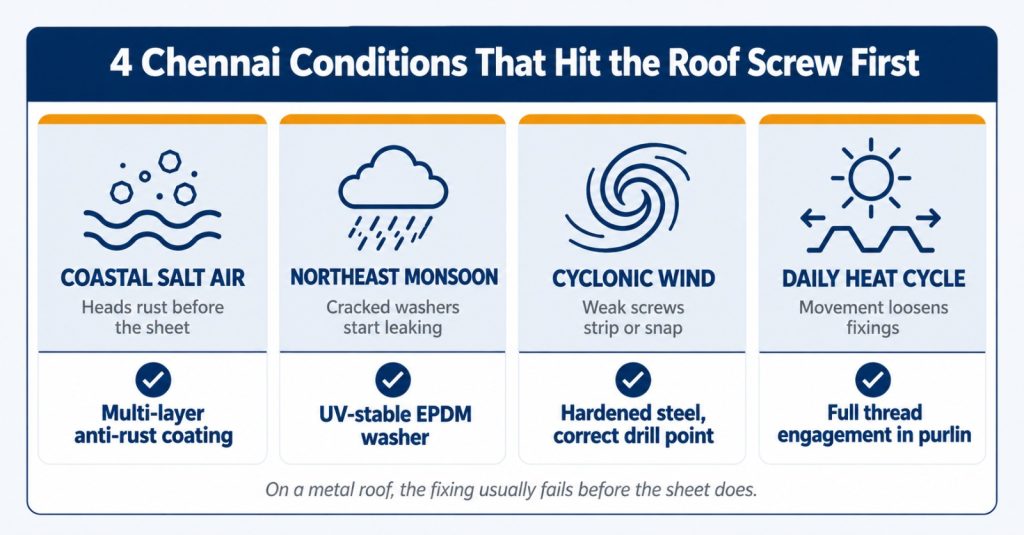
Chennai’s industrial belt runs close to the coast. Ennore, Manali, Ponneri, Gummidipoondi and the northern industrial areas are all exposed to salt-laden air, and humidity remains high for much of the year.
On a metal roof in these conditions, the fastener head is usually the first point where corrosion becomes visible, because:
- The head is a small, exposed metal surface facing directly into the weather
- Water collects around the washer and head after every rain
- Low-quality coatings break down faster than the coating on the roofing sheet
- Rust from the fastener can stain and damage the surrounding sheet coating
When fasteners corrode ahead of the sheet, the roof begins to fail at its fixings even while the sheets themselves are still sound. A fastener with a coating designed for extended salt spray exposure helps keep the fixings in step with the life of the sheet.
Monsoon Leaks Are Usually Fixing Leaks
The northeast monsoon between October and December brings Chennai’s heaviest rainfall, often driven by strong winds.
Many leaks reported after heavy rain trace back to fixing points rather than to the sheet. Common causes include:
- EPDM or rubber washers that have hardened, cracked or shrunk
- Fasteners driven at an angle, leaving the washer partially seated
- Over-driven screws that have squeezed the washer out of shape
- Corroded fastener heads allowing water to track down the shank
A quality EPDM washer that stays flexible under sustained heat and UV exposure is one of the main reasons buyers are moving to premium screws. On a roof with several thousand fixings, even a small percentage of failing washers can produce a long list of leak points.
Wind Uplift and the Need for Consistent Holding Strength
Chennai lies in a high wind zone and is periodically affected by cyclonic weather. During high winds, every sheeting fastener carries uplift load from the roof into the purlin.
Holding strength depends on several factors working together:
- Steel quality and heat treatment of the screw
- Thread form and engagement in the purlin
- Correct drill point selection for the purlin thickness
- Closer fixing spacing in edge zones such as eaves, ridges and roof corners
Inconsistent fasteners, where some screws strip or snap during driving, reduce the effective fixing pattern without anyone noticing. Buyers moving to branded screws are often looking for consistency from one packet to the next as much as for strength.
The purlin is the other half of the connection. Correctly sized purlin members, including the MS channels widely used as purlins in conventional sheds, give the screw sound material to engage with and help the fixing pattern perform as designed.
Premium Screws and Thermal Movement
Metal roofs expand in the afternoon heat and contract as they cool. Repeated every day for years, that movement places a steady load on each fastener.
Fasteners with poor thread engagement or brittle washers can loosen gradually, leading to elongated holes and leak paths. On long roof runs, where movement accumulates along the sheet, the quality of the fixing becomes even more important.
The way pre-engineered buildings are designed to accommodate this movement is explained in Metfraa’s blog on thermal expansion challenges in pre-engineered metal buildings. The fastener is the point where that design intent either holds or fails.
Matching the Screw to Premium Roofing Sheets
Many Chennai industries are already investing in higher-grade colour coated and aluminium-zinc coated roofing sheets with long coating warranties.
Using an inexpensive fastener on such a roof creates a mismatch: the sheet is specified for long service life, but the fixing is not. Problems at the fastener can also complicate warranty discussions, since many sheet warranties expect compatible accessories and correct installation.
Matching points that buyers increasingly check include:
- Fastener coating compatible with the sheet coating
- Washer diameter suited to the sheet profile and fixing position
- Screw length allowing full thread engagement in the purlin
- Head colour or finish appropriate for visible facades
The Total Cost Case for Switching
The purchase price of a premium screw is higher. The cost of a failed fastener is far higher.
| Cost Factor | Commodity Fasteners | Tata Agrico Screws |
| Purchase price per piece | Lower | Higher |
| Breakage or stripping during installation | More likely | Less likely |
| Washer life under sun and heat | Often shorter | Designed for extended outdoor use |
| Corrosion at the head | Often early in coastal areas | Coating designed for salt spray exposure |
| Leak repairs after monsoon | More frequent | Less frequent |
| Risk of re-fixing the roof | Higher | Lower |
| Disruption to operations | Higher over time | Lower over time |
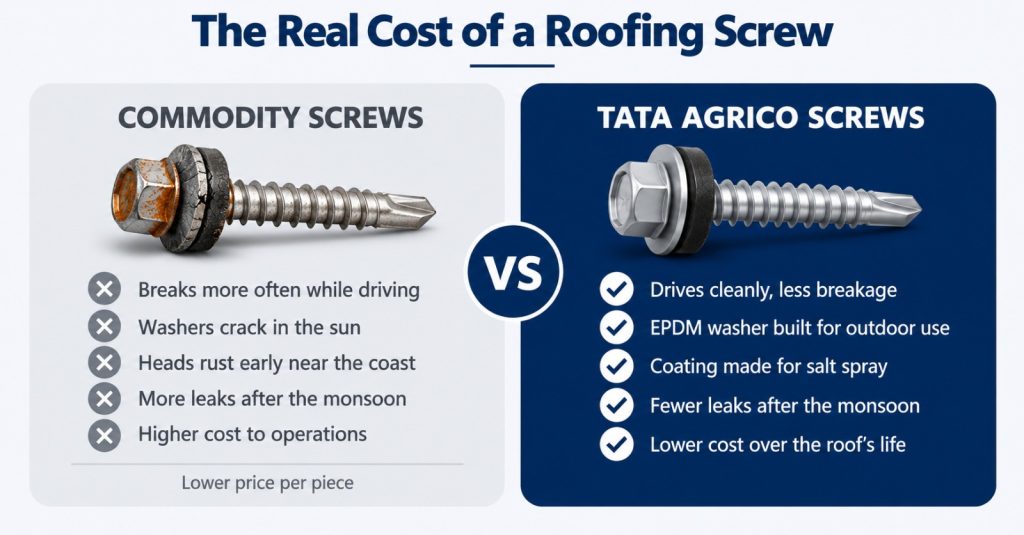
For an operating factory, the cost of a leak is rarely just the repair. It may include damaged stock, stopped production lines, wet electrical panels and maintenance crews working at height. Those costs are what drive the switch for many facility managers.
Genuine Supply Matters as Much as the Brand
As demand for Tata Agrico Roofing screws has grown, so has the risk of counterfeit and lookalike products in the market.
Buyers can reduce this risk by:
- Purchasing through an authorized distributor
- Checking packaging, labelling and batch details
- Inspecting head markings and washer quality
- Requesting invoices that clearly identify the product
- Being cautious of prices well below the market rate
A fastener that looks genuine but lacks the specified coating or heat treatment will not deliver the performance that justified the switch in the first place.
Common Mistakes When Switching to Premium Screws
Switching brands alone does not guarantee better results. Several issues can cancel out the benefit:
- Using a screw length that does not engage fully with the purlin
- Choosing the wrong drill point for thick or hot-rolled members
- Driving screws with impact drivers instead of controlled screw guns
- Over-driving and damaging the EPDM washer
- Mixing genuine and unbranded screws on the same roof
- Leaving drilling swarf on the sheet surface
- Keeping uniform fastener spacing at edges and corners
Installation practice and correct selection are what turn a premium screw into a premium fixing.
How Should You Switch to Tata Agrico Roofing Screws?
Step 1: Assess the building exposure Note distance from the coast, process fumes, humidity and wind exposure.
Step 2: Confirm the purlin specification Check purlin type and thickness to select the correct drill point and screw length.
Step 3: Select thread type and size Choose single or double thread and the correct diameter and length for each fixing location.
Step 4: Match washer and finish to the sheet Confirm washer size, coating compatibility and head finish for visible areas.
Step 5: Source from an authorized distributor Buy genuine stock with clear invoicing and batch identification.
Step 6: Brief the installation crew Set driving depth, tool type, fixing pattern and swarf clearance before work begins.
Conclusion
Tata Agrico Roofing screws are gaining ground across Chennai’s industrial sector because the city’s conditions expose the weaknesses of commodity fasteners quickly. Coastal corrosion, heavy monsoon rainfall, cyclonic wind and daily thermal movement all act on the fixing point first, and that is where premium screws are making a measurable difference.
The switch is being driven by total cost rather than purchase price. Fewer leaks, fewer replacements, lower disruption to operations and better alignment with long-life roofing sheets all support the decision.
The benefit depends on genuine supply, correct selection and good installation practice. Crayon Roofings & Structures supplies genuine Tata Agrico Roofing Screws along with roofing sheets, purlins and accessories, and has experience supporting industrial projects where the fastener needs to be matched to the sheet, structure and exposure.
If you are planning to switch your roofing fasteners or are specifying a new industrial roof in Chennai, contact us at Crayon Roofings & Structures to discuss your project requirements.
Frequently Asked Questions
1. Is Crayon Roofings & Structures an authorized distributor of Tata Agrico Roofing screws in Chennai?
Yes. Crayon Roofings & Structures is an authorized Tata Agrico distributor, supplying genuine self-drilling screws for industrial roofing projects across Chennai.
2. Are Tata Agrico Roofing screws suitable for coastal industrial areas in Chennai?
They are commonly used near the coast, as the Ruspert coating is designed for improved corrosion resistance in humid, salt-laden conditions.
3. Do premium roofing screws really reduce overall roofing cost?
Often, yes. Fewer leaks, less fastener replacement and longer service life can offset the higher purchase price over the roof’s life.
4. Which factors should be considered when switching to Tata Agrico Roofing screws?
Purlin thickness, screw length, thread type, washer condition, exposure, supplier authorization and installation practice should all be evaluated before switching.