
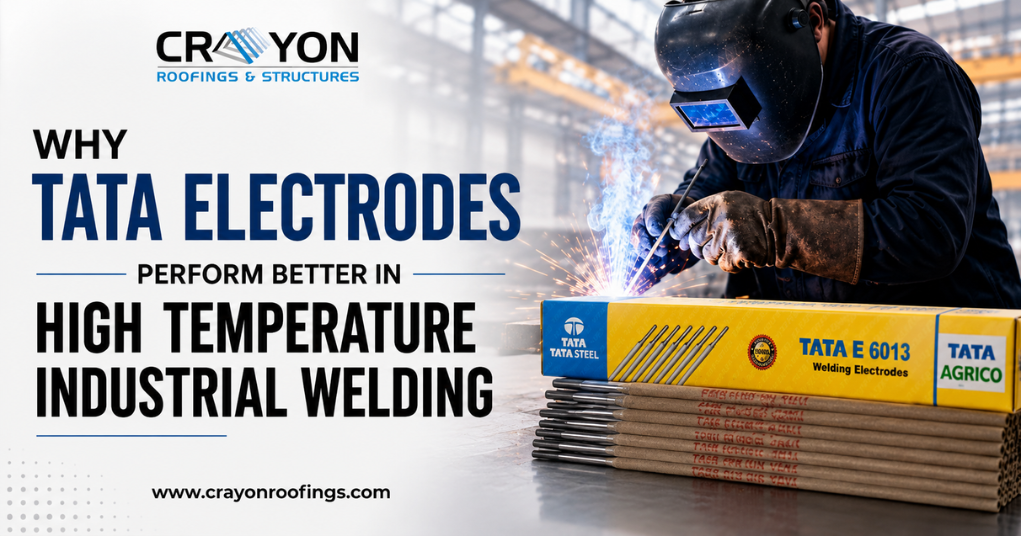
Industrial welding is more than simply joining two pieces of metal. In sectors such as power generation, petrochemicals, steel manufacturing, heavy engineering, and infrastructure, every weld must withstand demanding operating conditions for years. High temperatures, constant vibration, pressure, and cyclic loading can place tremendous stress on welded joints. If the wrong welding consumable is used, even a well-designed structure may require frequent repairs or suffer premature failure.
This is why experienced fabricators pay close attention to electrode selection. The right welding electrode not only creates a strong joint but also contributes to production efficiency, lower maintenance costs, and long-term reliability. Among the many options available in the market, Tata Electrodes has earned the confidence of industrial users by consistently delivering dependable welding performance across challenging applications.
This blog explores what sets Tata Electrodes apart and why they continue to be a preferred choice for high-temperature industrial welding.
Why Do High-Temperature Applications Need Premium Welding Electrodes?
Every welded structure behaves differently when exposed to heat. Boilers, furnaces, pressure vessels, pipelines, structural frames, and heavy machinery often experience repeated heating and cooling cycles during operation. These temperature changes cause metals to expand and contract, creating internal stresses around the weld.
When welding consumables are unable to cope with these conditions, problems may begin to appear over time, including:
- Surface and internal cracking
- Lack of proper fusion
- Excessive weld spatter
- Weak joint strength
- Distortion caused by heat
- Premature component failure
Repairing these defects can be expensive and may interrupt production schedules. Selecting high-quality industrial welding electrodes from the beginning helps reduce these risks while improving the overall durability of the welded structure.
What Makes Tata Electrodes a Preferred Choice?
Choosing an electrode is about much more than price. Industrial projects require consistency because even small variations in weld quality can affect safety and performance.
Manufactured with Consistent Quality Standards
Reliable welding begins with consistent manufacturing. Tata Electrodes are produced under stringent quality controls to ensure uniform coating, stable chemical composition, and dependable welding characteristics from one batch to the next.
This consistency allows welders to achieve repeatable results, particularly on projects where hundreds or even thousands of welds must meet strict quality requirements.
Smooth and Stable Arc Performance
A stable welding arc makes a noticeable difference during fabrication. It allows better control over the weld pool, resulting in cleaner weld beads and improved penetration.
With Tata Electrodes, welders often experience:
- Easy arc striking
- Smooth metal transfer
- Better bead appearance
- Reduced interruptions during welding
- Improved operator control
These characteristics help increase productivity while reducing unnecessary rework.
Stronger Welded Joints
Industrial equipment is expected to perform under demanding service conditions. Welded joints must withstand mechanical loads, vibration, and thermal stress throughout their operating life.
Tata Electrodes are engineered to produce welds with excellent mechanical properties, helping fabricators achieve stronger joints with improved reliability.
Performance Advantages in High-Temperature Industrial Welding
Better Resistance to Thermal Cycling
Industrial equipment rarely operates at a constant temperature. Components often heat up during operation and cool down once production stops. Over time, this repeated expansion and contraction can weaken poor-quality welds.
Electrodes that produce sound, defect-free welds help minimise the impact of thermal cycling, improving the service life of fabricated components.
Cleaner Welds with Fewer Defects
Every fabrication workshop aims to reduce repair work because rework consumes time, labour, and materials.
Quality welding electrodes contribute to cleaner welds by helping minimise common issues such as:
- Porosity
- Slag inclusions
- Undercutting
- Excessive spatter
- Incomplete fusion
Reducing these defects leads to smoother fabrication workflows and more consistent quality inspections.
Improved Weld Penetration
Proper weld penetration is essential for creating joints capable of carrying heavy loads. Insufficient penetration can compromise structural integrity, particularly in heavy engineering applications.
Tata Electrodes provide controlled penetration that supports stronger welds while maintaining excellent bead appearance.
Selecting the Right Tata Electrode for the Job
Different projects call for different welding consumables. Choosing the correct electrode depends on the material grade, joint design, welding position, and service conditions.
Mild Steel Electrodes
These electrodes are commonly used for general fabrication, structural work, industrial maintenance, and routine construction projects involving mild steel components.
Low Hydrogen Electrodes
Critical structures often require additional protection against weld cracking. Low hydrogen electrodes are specially formulated to limit hydrogen pickup during welding, helping improve weld integrity in demanding fabrication applications such as bridges, pressure vessels, heavy structural assemblies, and thick steel sections.
Low Alloy Steel Electrodes
Where additional strength and heat resistance are required, low alloy steel electrodes provide enhanced mechanical performance suitable for specialised industrial applications.
Stainless Steel Electrodes
Industries that work with stainless steel equipment benefit from electrodes designed to maintain corrosion resistance while producing clean, durable welds.
Selecting an electrode that matches both the base material and the intended service conditions helps maximise weld quality and long-term performance.
Industries That Depend on Reliable Welding Performance
High-quality welding consumables play an important role across a wide range of industries.
Some of the major sectors where Tata Electrodes are widely used include:
- Thermal power stations
- Steel processing plants
- Cement manufacturing units
- Petrochemical facilities
- Oil and gas installations
- Pressure vessel fabrication
- Boiler manufacturing
- Shipbuilding
- Heavy engineering
- Infrastructure development
- Structural steel fabrication
In these industries, dependable welding directly contributes to operational safety, equipment longevity, and reduced maintenance requirements.
Why More Industrial Fabricators Prefer Tata Electrodes
Selecting a premium welding electrode is an investment in quality rather than an added expense. Although lower-cost alternatives may appear attractive initially, inconsistent weld quality often leads to repairs, production delays, and higher maintenance costs over the life of a project.
Fabricators who use Tata Electrodes appreciate the practical advantages they bring to everyday welding operations.
Some of the key benefits include:
- Reliable arc stability throughout the welding process
- Uniform weld bead appearance with minimal finishing work
- Consistent penetration across various steel grades
- Reduced weld spatter, resulting in cleaner work areas
- Easier slag removal, improving productivity
- Strong mechanical properties for demanding applications
- Lower chances of weld discontinuities when proper procedures are followed
- Improved efficiency during repetitive fabrication work
Together, these advantages help improve overall fabrication quality while reducing the time spent on inspection and rework.
Best Practices for Getting the Best Results with Tata Electrodes
Even premium welding consumables deliver the best performance only when paired with proper welding practices. Paying attention to preparation and handling can significantly improve weld quality and extend the service life of fabricated components.
For consistent results:
- Store electrodes in a clean, dry environment to prevent moisture absorption.
- Use the recommended welding current for the selected electrode.
- Prepare the joint by removing rust, oil, paint, scale, and other contaminants.
- Select an electrode compatible with both the material grade and the intended application.
- Maintain a steady arc length throughout the weld.
- Follow approved Welding Procedure Specifications (WPS) wherever applicable.
- Inspect completed welds to verify quality before components are placed into service.
Small improvements in welding practice often have a significant impact on the durability and appearance of the finished weld.
Tata Electrodes vs Conventional Welding Electrodes
The quality of a welded joint depends on several factors, but the electrode remains one of the most influential. While conventional electrodes may be suitable for routine fabrication, demanding industrial environments often require more consistent performance.
| Feature | Tata Electrodes | Conventional Electrodes |
| Arc Stability | Consistent and smooth | May vary between batches |
| Weld Penetration | Reliable and uniform | Can be inconsistent |
| Weld Appearance | Clean, uniform bead | May require additional finishing |
| Spatter Generation | Lower | Comparatively higher |
| Slag Removal | Easy | Moderate |
| Mechanical Strength | Suitable for demanding applications | Depends on product quality |
| Long-Term Reliability | High | Varies considerably |
For industries where weld quality affects equipment safety and operational uptime, investing in dependable welding consumables often proves more economical over the long term.
Why Buying from an Authorized Tata Electrodes Distributor Matters
The performance of a welding electrode depends not only on its manufacturing quality but also on how it is stored and handled before it reaches the welder. Improper storage conditions can affect the condition of welding consumables and, ultimately, the quality of the weld.
Purchasing from an authorized distributor offers several advantages:
- Genuine Tata products
- Proper storage and inventory management
- Access to technical product recommendations
- Reliable product availability
- Manufacturer-backed quality assurance
For customers across Tamil Nadu and South India, Crayon Roofings is an authorized distributor of Tata Electrodes. Along with supplying genuine welding consumables, the company supports fabrication businesses by helping them choose products suited to their specific industrial applications.
Key Takeaways
- High-temperature welding places significant demands on weld quality and joint reliability.
- Premium welding consumables contribute to stronger, more durable welds.
- Tata Electrodes are recognised for their stable arc characteristics, consistent penetration, and dependable mechanical properties.
- Selecting the correct electrode for the application helps improve fabrication quality and reduce maintenance requirements.
- Proper storage, handling, and welding practices are equally important for achieving optimum results.
- Purchasing from an authorized distributor helps ensure product authenticity and dependable technical support.
Conclusion
Producing durable welds for high-temperature industrial applications requires more than skilled workmanship. The choice of welding consumable has a direct influence on weld integrity, fabrication efficiency, and the long-term performance of industrial equipment.
Tata Electrodes continues to be a preferred choice for fabricators because they combine consistent manufacturing quality with reliable welding performance across a wide range of applications. From structural steel fabrication and heavy engineering to boilers, pressure vessels, and process industries, these electrodes help create welds capable of meeting demanding service conditions.
Businesses looking for genuine Tata Electrodes should always purchase through an authorized distributor to ensure product authenticity and proper handling. For industries across Tamil Nadu and neighbouring regions, Contact Crayon Roofings supplies genuine Tata Electrodes backed by dependable service and product expertise, helping customers achieve reliable welding performance on every project.
Frequently Asked Questions
Q. Why are Tata Electrodes widely used in industrial fabrication?
Their consistent manufacturing quality, dependable arc performance, and reliable mechanical properties make them suitable for fabrication projects where weld quality is critical.
Q. Which Tata Electrodes are suitable for high-temperature applications?
The appropriate electrode depends on the material grade, joint design, and service conditions. Low-hydrogen and low-alloy variants are commonly selected for applications that involve elevated temperatures and critical welded structures.
Q. Can Tata Electrodes help reduce welding defects?
When used with proper welding procedures, Tata Electrodes can help minimise common issues such as excessive spatter, porosity, slag inclusions, and incomplete fusion, contributing to cleaner and stronger welds.
Q. Are Tata Electrodes suitable for structural steel fabrication?
Yes. They are widely used for structural steel fabrication, industrial buildings, bridges, pressure vessels, heavy engineering equipment, and infrastructure projects.
Q. How should welding electrodes be stored?
Electrodes should be kept in a dry environment away from moisture. Following the manufacturer’s storage recommendations helps preserve their welding characteristics and ensures consistent performance.