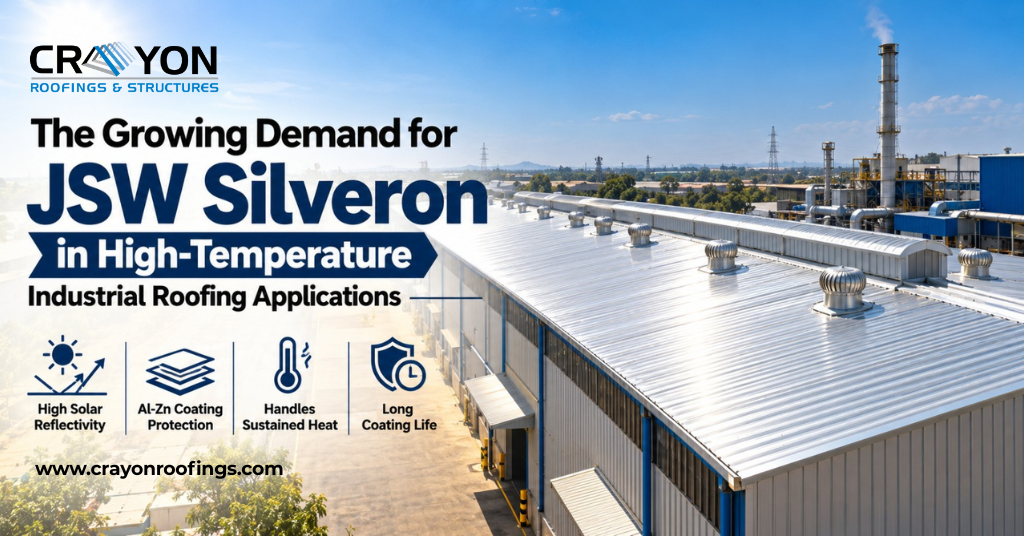
JSW Silveron is being specified more often on industrial buildings where heat, rather than rain, is the condition the roof has to manage every working day. Foundries, forging shops, boiler houses, heat treatment units and large process sheds across Tamil Nadu operate with internal heat loads that sit on top of an already hot climate.
In these buildings, the roof is not only a weather cover. It influences working temperature, energy use for cooling and ventilation, and how quickly the coating on the sheet ages.
That combination is the main reason JSW Silveron and other bare aluminium-zinc coated sheets have become a common choice for this category of roofing.
Crayon Roofings & Structures is an authorized distributor of JSW colour coated sheets with a JSW Experience Centre at its facility, and supplies roofing sheets, purlins and accessories for industrial projects where the sheet specification must be matched to the operating conditions inside the building. The important part is not simply supplying a premium sheet, but confirming that it suits the heat, exposure and fixing arrangement of the specific roof.
So, what makes JSW Silveron suited to hot industrial environments, and where does it need careful detailing?
What Is JSW Silveron?
JSW Silveron, marketed in its current form as JSW Silveron+, is a bare Galvalume sheet. The steel substrate carries a metallic coating made of aluminium, zinc and a small proportion of silicon, without a paint layer over it.
That bare metallic finish is what gives JSW Silveron its bright silver surface, and it is the reason the product behaves differently from colour-coated sheets in hot conditions.
JSW describes Silveron+ as India’s first ISI-approved Galvalume sheet, and JSW Steel was the first licensee of the Galvalume coating technology in India. The product is generally supplied in high-tensile grades, with a coating mass designation such as AZ150 and thicknesses commonly in the 0.35 mm to 0.50 mm range for roofing profiles.
As with any coated sheet, the exact grade, coating mass and thickness for a project should be confirmed from the manufacturer’s current product data rather than assumed.
Why High-Temperature Buildings Place Different Demands on the Roof
A standard warehouse roof deals mainly with sun from above and rain from the sky. A high-temperature process building deals with heat from both sides.
Buildings in this category typically include:
- Foundries and casting units
- Forging and heat treatment shops
- Boiler houses and power utility buildings
- Glass, ceramic and refractory processing units
- Kiln sheds and drying units
- Large fabrication shops with continuous welding and cutting
In these structures, hot air rises and collects directly under the roof sheet. The underside of the sheet can remain warm through the working day and into the night, while the top surface is exposed to direct sun.
This places three demands on the roofing sheet that are less significant in ordinary buildings: the coating must tolerate sustained elevated temperature, the sheet surface should limit heat gain from the sun, and the fixing system must accommodate more thermal movement.
How the JSW Silveron Coating Handles Heat
On JSW Silveron, the coating is the part of the sheet that most directly determines how it ages in a hot environment.
In an aluminium-zinc coating, the two metals do different jobs. Aluminium forms a stable oxide layer that acts as a barrier, while zinc provides sacrificial protection at scratches and cut edges. Silicon is added mainly to control the bond between the coating and the steel during manufacture.
Compared with a conventional zinc coating, an aluminium-zinc coating is generally regarded as more tolerant of elevated service temperatures, since zinc on its own tends to oxidise and darken more quickly with sustained heat.
This does not mean JSW Silveron is a heat-resistant material in the industrial furnace sense. Direct flame, localised hot exhaust or radiant heat very close to the underside of the roof are separate conditions that need their own design treatment, such as shielding or isolating the roof zone above the heat source.
Heat Reflectivity and Its Effect on Working Temperature
The bright metallic surface of JSW Silveron reflects a substantial part of incoming solar radiation.
On a large industrial roof, reduced solar heat gain can contribute to:
- Lower surface and under-roof temperatures during peak sun hours
- A reduced load on ventilation and cooling systems
- More comfortable working conditions at floor level
- Slower thermal ageing of the roof components
The degree of benefit depends on several factors, including roof slope, building height, ventilation, insulation and how clean the sheet surface is kept. Dust from process operations can settle on the roof and reduce reflectivity over time, which is relevant in foundries and cement-adjacent sites.
It is also worth noting that a bright metallic surface reflects heat well but releases absorbed heat less readily than some painted surfaces. In buildings with very high internal heat loads, ventilation design often matters as much as the sheet surface itself.
JSW Silveron vs Colour Coated and GI Sheets in Hot Conditions
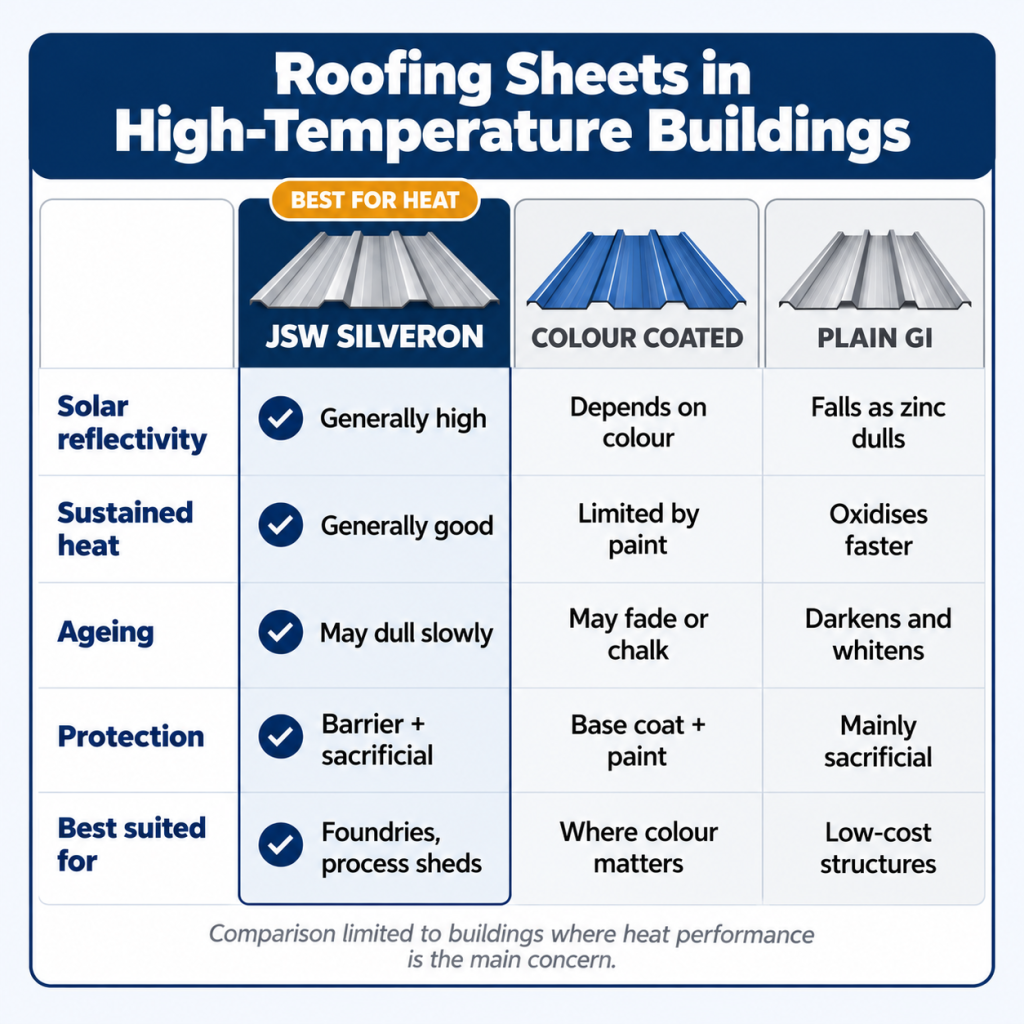
Each sheet type has a place in industrial roofing. The table below compares them specifically for high-temperature applications.
| Factor | JSW Silveron (Bare Galvalume) | Colour Coated Sheet | Plain GI Sheet |
| Surface | Bare aluminium-zinc metallic | Paint system over metallic coating | Bare zinc |
| Solar reflectivity | Generally high | Depends on paint colour | Moderate, reduces as zinc dulls |
| Tolerance to sustained heat | Generally good | Limited by the paint system | Lower; zinc oxidises faster |
| Appearance over time | Silver finish, may dull gradually | Colour may fade or chalk | Darkens and whitens with age |
| Corrosion protection | Barrier plus sacrificial action | Depends on base coating and paint | Mainly sacrificial |
| Typical use in hot buildings | Process sheds, foundries, utilities | Where appearance or branding matters | Temporary or low-cost structures |
JSW colour coated sheets remain the preferred choice where building appearance matters or where a specific colour is required. The comparison here is limited to buildings where heat performance is the primary concern.
Thermal Expansion and Movement on Long Roof Runs
Steel sheets expand as they heat up and contract as they cool.
In a high-temperature building, the daily temperature cycle of the roof sheet can be larger than on a normal roof, because the sheet is heated from below by the process and from above by the sun. On long ridge-to-eaves runs, this movement accumulates along the length of the sheet.
If the movement is restrained, it may lead to:
- Elongated fastener holes over time
- Stress on side laps and end laps
- Buckling or waviness in the pans
- Loosening of flashings at ridges and eaves
The approach to thermal movement is normally addressed at the design stage through sheet length, fixing arrangement and flashing details. For very long runs, manufacturers’ recommendations on maximum sheet length and expansion provisions should be followed. The purlins and supporting structural steel should also be checked for this movement, since restrained expansion transfers load into the fixings.
Fasteners and Accessories for a JSW Silveron Roof
A Galvalume sheet performs only as well as the components fixed to it.
The fasteners should be selected for the purlin thickness and should carry a coating compatible with an aluminium-zinc surface. Bonded EPDM washers should suit the operating temperature of the roof, since sustained heat can age a washer faster than on a standard roof.
As an authorized distributor for Tata Agrico self-drilling screws, Crayon Roofings & Structures can help match the fastener specification to the sheet and the supporting structure.
Other compatibility points commonly noted for JSW Silveron and similar aluminium-zinc coated sheets include:
- Avoiding direct contact with copper, lead or water run-off from copper components
- Avoiding contact with wet concrete, mortar or treated timber
- Clearing metal swarf after drilling, since it can rust and stain the surface
- Using compatible flashings and ridge accessories rather than dissimilar metals
Ventilation and Insulation Alongside JSW Silveron
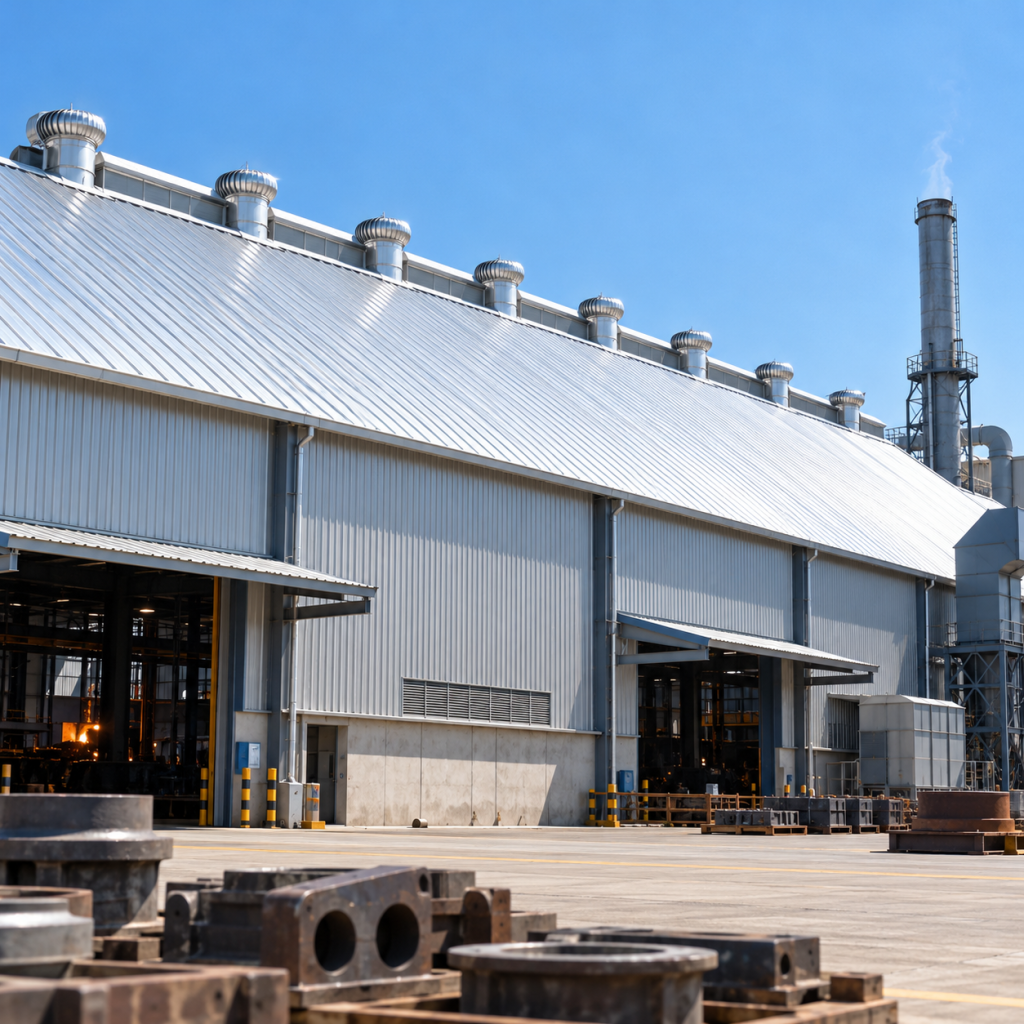
The roofing sheet is one part of the heat management system in a hot building, not the whole of it.
Ridge ventilators and turbo ventilators allow hot air collecting under the roof to escape, which can reduce the temperature at the underside of the sheet as well as at working level. Under-deck insulation may be used where the process allows it, although in some high-temperature buildings insulation is limited by fire safety or process requirements.
Translucent sheets are sometimes added for daylighting. In hot process buildings, their position relative to heat sources and their own temperature rating need to be checked, since they generally tolerate heat differently from steel.
Where the roof is part of a pre-engineered building, ventilator openings, purlin layout and roof slope are fixed at the structural design stage, so heat management should be considered before the design is frozen rather than after the frame is erected.
Why Demand for JSW Silveron Is Growing in Industrial Roofing
Several practical factors are influencing specifiers and plant owners towards JSW Silveron for hot buildings.
Industrial expansion in Tamil Nadu has added many process facilities where internal heat loads are significant. Rising electricity costs have made the energy load of cooling and ventilation more visible in operating budgets. At the same time, plant owners are paying closer attention to roof life, since re-roofing an operating process building means production disruption.
A sheet that offers heat reflectivity, good tolerance to elevated temperature and long coating life addresses all three concerns in one specification. That is broadly why JSW Silveron appears more frequently in tenders for process buildings, utility structures and heavy fabrication sheds. The wider case for aluminium-zinc sheets in factories is covered in our blog on Al Zn roofing for industrial applications.
The demand does not remove the need for project-specific selection. A foundry near the coast, a boiler house inland, and a glass unit with corrosive process fumes may each need a different combination of sheet, coating mass and accessories.
How Should You Select JSW Silveron for a High-Temperature Building?
Step 1: Map the heat sources Identify where furnaces, kilns, boilers or hot exhausts sit relative to the roof, and whether any zone needs shielding or isolation.
Step 2: Assess the environment Consider coastal exposure, process fumes, dust and humidity alongside temperature.
Step 3: Confirm the JSW Silveron specification Select thickness, grade and coating mass from the manufacturer’s current data, matched to the purlin spacing and span.
Step 4: Plan for thermal movement Review sheet lengths, fixing arrangement and flashing details for the expected temperature cycle.
Step 5: Specify compatible accessories Select fasteners, washers, flashings and ridge components compatible with an aluminium-zinc surface and the operating temperature.
Step 6: Integrate ventilation and daylighting Position ventilators and translucent sheets as part of the roof layout, checked against the heat sources below.
Conclusion
JSW Silveron is increasingly used in high-temperature industrial roofing because its bare aluminium-zinc coating combines solar reflectivity, good tolerance to elevated service temperatures and long coating life. In foundries, forging shops, boiler houses and process sheds, these characteristics address the heat load that ordinary roofing specifications are not designed around.
The sheet is only one part of the solution. Thermal movement, fastener and washer compatibility, ventilation, and the position of heat sources below the roof all influence how the roof performs over its service life.
For plant owners and project teams, the most reliable outcome comes from selecting the sheet, accessories and ventilation together, with reference to the actual operating conditions of the building. Crayon Roofings & Structures supplies roofing sheets, structural steel and roofing accessories, and has experience supporting industrial projects where the roofing specification needs to be matched to heat and exposure conditions.
If you are planning a roof for a high-temperature industrial building and want to discuss whether JSW Silveron suits your application, contact us at Crayon Roofings & Structures to discuss your project requirements.
Frequently Asked Questions
1. Can Crayon Roofings & Structures help select JSW Silveron for high-temperature industrial roofing?
Crayon Roofings & Structures helps match JSW Silveron thickness, coating mass and fasteners to the heat and exposure conditions of each building.
2. What is the difference between JSW Silveron and colour coated roofing sheets?
JSW Silveron is bare aluminium-zinc coated steel without paint, while colour coated sheets carry a paint layer over the metallic coating.
3. Does JSW Silveron need compatible fasteners and accessories?
Yes. Fasteners, washers and flashings should suit an aluminium-zinc surface, and contact with copper, lead or wet concrete should be avoided.
4. Which factors should be considered when selecting JSW Silveron roofing?
Heat sources, coastal exposure, thickness, coating mass, thermal movement, fastener compatibility and ventilation should all be evaluated before selection.