
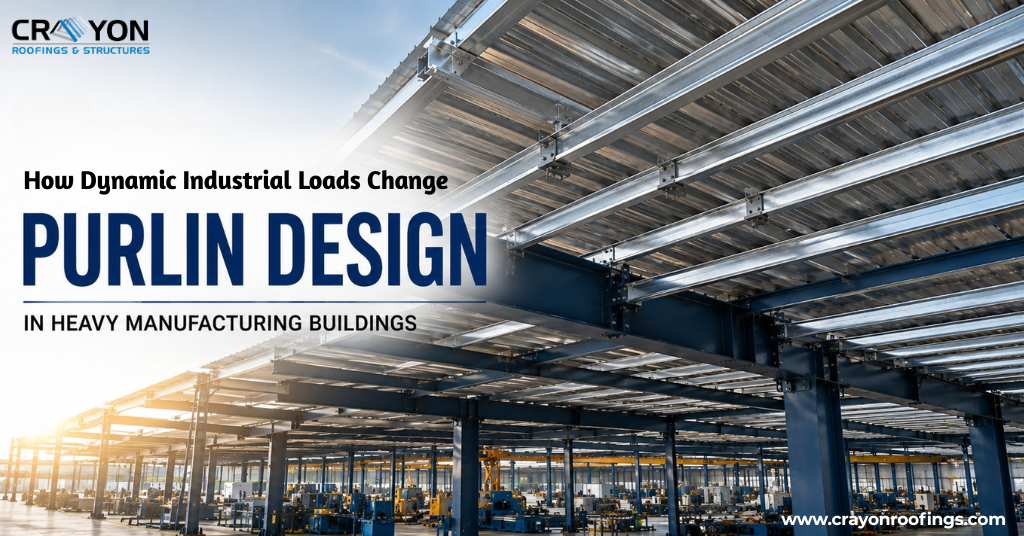
Heavy manufacturing buildings operate under far more demanding conditions than conventional industrial facilities. Overhead cranes, high-capacity machinery, continuous production cycles, and repetitive vibration generate dynamic industrial loads that constantly interact with the structural framework. Among the components most affected is the purlin, a secondary steel member responsible for supporting roof and wall cladding while transferring loads to the primary structural frame.
Traditionally, purlin design focused on dead loads, live loads, and wind loads. Today, engineers must also consider fatigue, cyclic loading, structural stability, and long-term serviceability. As manufacturing technologies evolve, designing industrial purlins for dynamic loading has become essential for ensuring safe, durable, and efficient industrial buildings.
A purlin is a secondary structural member that supports roof or wall cladding and transfers loads to the main steel framework. Manufactured primarily from cold-formed steel, purlins are available as C Purlins and Z Purlins and are widely used in PEB structures, warehouses, factories, logistics hubs, and other industrial roofing systems.
Why Purlins Matter in Heavy Manufacturing Buildings
Unlike commercial buildings, heavy manufacturing plants experience continuous operational forces that can significantly affect structural performance over time. Well-designed steel purlins not only support roofing materials but also contribute to efficient load distribution, improve the stiffness of the roof support system, and enhance the overall stability of the steel framing system.
In facilities of housing stamping presses, rolling mills, foundries, automotive assembly lines, or material-handling equipment, purlins are subjected to repeated loading cycles. Even relatively small but continuous vibrations can gradually reduce the service life of structural members if fatigue is not considered during design.
Modern industrial construction therefore treats purlins as critical structural components rather than simple roof supports.
How Dynamic Industrial Loads Affect Purlin Design
Dynamic loads are forces that change continuously in magnitude, direction, or frequency. Unlike static loads, they introduce repeated stresses that require more advanced structural analysis.
Why Do Dynamic Loads Matter More Than Static Loads?
Static loads generally remain constant throughout a building’s life. Dynamic industrial loads fluctuate as machinery operates, cranes move, or production equipment starts and stops. These repeated stress cycles increase fatigue, influence connection performance, and may accelerate structural deterioration if not properly addressed.
Instead of designing only strength, engineers must also evaluate vibration, deflection, resonance, and long-term serviceability.
How Do Crane Loads Influence Steel Purlins?
Although overhead cranes primarily transfer loads to primary structural members, their movement generates vibrations that can affect the surrounding roof framing. Frequent lifting operations create cyclic forces that influence purlin connections and supporting members.
Proper structural analysis helps ensure that purlins continue performing reliably under these operational conditions.
Can Machinery Vibration Reduce Purlin Life?
Yes. Rotating equipment, compressors, turbines, conveyor systems, and heavy production machinery generate continuous vibrational loads. Over time, repeated stress cycles may contribute to fatigue cracking, loose fasteners, excessive deflection, or localized deformation if the purlin system has not been designed for these operating conditions.
Common Dynamic Load Sources
- Overhead crane operations
- Vibrating industrial machinery
- Cyclic production equipment
- Wind-induced vibration
- Impact loading
- Thermal expansion and contraction
- Future equipment upgrades
At a Glance
- Dynamic loads create repeated structural stress.
- Fatigue is often more critical than ultimate strength.
- Load distribution changes during machine operation.
- Proper connection detailing improves structural reliability.
- Periodic inspection helps identify early fatigue-related issues
A purlin designed only for static loads may satisfy basic structural requirements but still experience premature fatigue or excessive deflection in heavy manufacturing environments where repetitive operational forces are common.
Key Design Considerations for Industrial Purlins
Selecting the right purlin involves balancing structural performance, durability, constructability, and future operational requirements.
Key design factors include:
- Appropriate steel grade
- Selection between C Purlins and Z Purlins
- Span length
- Roof loading
- Crane influence
- Fatigue resistance
- Connection detailing
- Corrosion protection
- Building expansion plans
- Compatibility with the overall industrial roofing system
Step-by-Step Engineering Approach
- Determine dead, live, wind, and dynamic industrial loads.
- Evaluate machinery vibration and crane operating conditions.
- Select an appropriate cold-formed steel section.
- Verify bending strength, shear capacity, and allowable deflection.
- Design connections capable of resisting repeated loading.
- Check fatigue performance where cyclic loading is expected.
- Confirm compliance with IS 800 and IS 801.
- Review future production expansion before finalizing the section size.
Static Loads vs Dynamic Loads
How Do Design Priorities Change?
Designing static loads focuses primarily on strength and deflection. Designing dynamic industrial loads also requires evaluating fatigue life, vibration control, connection durability, and long-term structural performance.
C Purlins vs Z Purlins
Both profiles are widely used in steel framing systems, but their suitability depends on span requirements and structural continuity.
C Purlins
- Suitable for shorter spans
- Easier fabrication and installation
- Frequently used for wall systems
- Ideal for smaller roof bays
Z Purlins
- Better overlap continuity
- Suitable for longer spans
- Improved load distribution
- Preferred for large industrial roofing systems and heavy manufacturing buildings
The final selection should always be based on structural analysis rather than profile preference alone.
Practical Engineering Example
Consider a manufacturing plant with multiple overhead cranes operating across three production shifts. Although the roof dead load remains unchanged, continuous crane movement introduces repeated cyclic forces into the surrounding roof support system.
Rather than simply increasing the purlin size, engineers often improve performance by selecting higher-strength structural steel, optimizing connection details, verifying fatigue resistance, and reviewing vibration behavior during structural analysis. This approach provides a more efficient and durable solution while supporting long-term operational reliability.
Best Practices for Reliable Purlin Performance
Well-designed industrial purlins deliver their full value only when engineering, procurement, fabrication, and installation are aligned. Selecting the right section is important, but material quality, connection detailing, and routine maintenance ultimately determine long-term structural performance.
How Can Engineers Improve Long-Term Purlin Performance?
A reliable purlin system begins with accurate structural analysis and extends through the building’s operational life. Engineers should focus on:
- Selecting certified structural steel with suitable strength.
- Choosing galvanized or corrosion-resistant finishes for harsh industrial environments.
- Designing connections to accommodate repetitive loading.
- Coordinating purlins with roofing sheets, fasteners, and supporting members.
- Planning for future production expansion and equipment upgrades.
When procuring materials, compatibility between purlins, metal roofing sheets, roofing screws, and roofing accessories helps create a durable industrial roofing system rather than treating each component independently.
Common Design Mistakes to Avoid
Many long-term structural issues originate from avoidable design or procurement decisions, including:
- Underestimating crane-induced vibration.
- Ignoring fatigue caused by cyclic loading.
- Selecting purlins based only on initial cost.
- Using inadequate connection details.
- Neglecting corrosion protection.
- Failing to account for future equipment additions or plant expansion.
Avoiding these mistakes improves lifecycle performance and reduces maintenance costs.
Inspection and Maintenance
Routine inspections help identify early signs of deterioration before they affect structural integrity. Maintenance teams should periodically inspect for:
- Loose bolts and fasteners
- Excessive deflection
- Corrosion or coating damage
- Fatigue cracks near connections
- Water ingress around roofing components
- Local deformation caused by repeated loading
Preventive maintenance generally extends the service life of industrial purlins while reducing unexpected shutdowns and repair costs.
Why Are IS 800 and IS 801 Important?
In India, IS 800 provides design guidance for structural steel, while IS 801 covers cold-formed light-gauge steel members commonly used for purlins. Together, these standards help engineers verify strength, stability, serviceability, and safe structural behavior under various loading conditions.
Following these standards, promote consistent engineering practices and support reliable performance throughout a building’s lifecycle.
Decision Checklist
Before approving a purlin specification, confirm the following:
For Structural Engineers
✔ Dynamic and static load combinations verified
✔ Fatigue and vibration assessed
✔ Deflection within permissible limits
✔ Compliance with IS 800 and IS 801 confirmed
For PEB Designers
✔ Correct C or Z purlin profile selected
✔ Efficient load distribution achieved
✔ Roof support system coordinated with primary framing
For EPC Contractors
✔ Installation sequence reviewed
✔ Connection details checked before erection
✔ Material quality verified at site
For Procurement Teams
✔ Structural steel certifications obtained
✔ Galvanization and coating specifications verified
✔ Dimensions and tolerances confirmed
✔ Supplier quality documentation approved
Expert Perspective: Designing Purlins for Evolving Industrial Demands
From practical project experience, roofing specialists such as Crayon Roofings have observed that projects achieve better long-term performance when purlins, roofing sheets, fasteners, and related steel roofing components are selected as a coordinated system. Proper material compatibility and installation practices often reduce maintenance issues and improve structural reliability in demanding industrial environments.
As heavy manufacturing facilities become more automated and production equipment continues to evolve, dynamic industrial loads play an increasingly important role in modern purlin design. Engineers must move beyond conventional static load assumptions and evaluate fatigue, vibration, connection performance, and long-term serviceability to ensure structural reliability.
Selecting high-quality industrial purlins, performing detailed structural analysis, and complying with IS 800 and IS 801 help create durable steel framing systems capable of supporting demanding industrial operations. Equally important are coordinated procurement, proper installation, and routine maintenance, which together maximize the service life of the roof support system.
For project-specific guidance on purlin selection and industrial roofing systems, contact Crayon Roofings. Their team can help evaluate operational requirements, environmental conditions, and future expansion needs to recommend suitable purlin solutions for safe, durable, and efficient heavy manufacturing buildings.
Frequently Asked Questions ( FAQ):
Q. Why do dynamic industrial loads affect purlin design?
Dynamic industrial loads generate repeated stresses from machinery, cranes, and production equipment. Unlike static loads, these forces can increase fatigue, vibration, and long-term deflection, requiring more detailed structural analysis during purlin design.
Q. Which purlin is better for heavy manufacturing buildings—C or Z?
The choice depends on span length, continuity requirements, and structural analysis. Z purlins are generally preferred for longer spans and larger industrial roofing systems, while C purlins are suitable for shorter spans and wall applications.
Q. Do crane loads directly act on purlins?
Crane loads are primarily transferred through the primary structural frame. However, crane movement and operational vibrations can influence surrounding roof support systems, making it important to evaluate their indirect effects on purlin performance.
Q.Can existing purlins be upgraded for heavier machinery?
In many cases, yes. Engineers may strengthen connections, replace sections with higher-capacity steel purlins, or modify the supporting framework after conducting a detailed structural assessment.
Q. What is the difference between roof purlins and wall purlins?
Roof purlins support roof cladding and transfer roof loads to the primary frame, whereas wall purlins (commonly called girts) support wall cladding and resist lateral wind loads.