
Tata screws in Chennai are widely used by roofing contractors to fix metal sheets on factories, warehouses and commercial buildings. Each screw drills its own hole, cuts its own thread and seals the joint in a single action, usually within a few seconds. To get that result, the tip, the cutting flutes, the threads and the washer all have to work one after another in the right order.
Understanding this sequence helps contractors choose the right screw, set their tools correctly and avoid the fixing faults that show up as leaks after the first monsoon.
Contractors and fabricators looking for Tata screws in Chennai often source genuine Tata Agrico fasteners through Crayon Roofings & Structures, an authorized Tata Agrico distributor for self drilling screws, welding electrodes and grinding wheels. Knowing how the screw actually cuts and grips steel makes it much easier to pick the right size and drill point for each purlin on site.
So what really happens inside those few seconds of driving, and why does it matter on a Chennai roof?
How a Self Drilling Screw Differs From a Self Tapping Screw
A self tapping screw needs a hole drilled beforehand, while a self drilling screw carries its own drill at the tip, so it can make the hole and thread into it in one go. That is what gives these screws their speed on site. It also means the tip must be hard enough to cut steel, while the body behind it stays tough enough to hold load without snapping.
The Three-Stage Drilling Action Explained
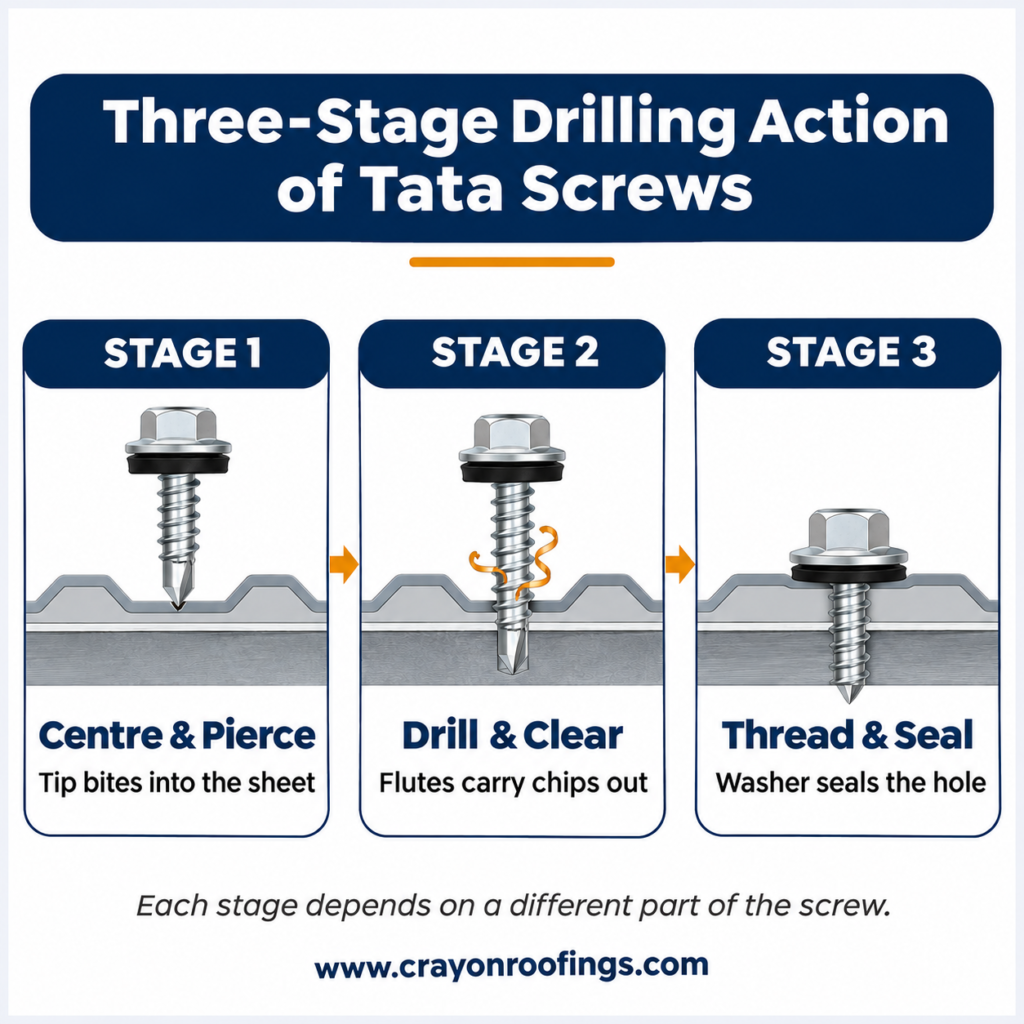
The driving cycle of a self drilling roofing screw can be understood in three stages, and each stage depends on a different part of the screw.
Stage 1: Centring and Piercing
The cycle starts at the very tip. As the screw begins to spin under light pressure, the point locates itself on the sheet and pierces the coated surface without skating across it.
On a painted roofing sheet, this matters more than it sounds. If the tip wanders before biting, it scratches the coating, leaves the screw off-centre on the crest and can stop the washer from seating flat later on.
Stage 2: Drilling and Clearing Chips
Once the tip is through the sheet, the cutting edges reach the purlin. This is where the real drilling happens.
The edges shave away steel as the screw turns, and the flutes, the spiral grooves running up from the tip, carry those chips out of the hole. If the chips are not cleared, they pack into the hole, generate heat and slow the cut.
This stage only works properly when the drill point is matched to the steel thickness. The unthreaded length behind the tip needs to be long enough to finish the hole before the threads arrive. If the threads reach the steel too early, they try to grip while the hole is still being cut, and the screw can jam or snap.
Stage 3: Threading, Clamping and Sealing
When the hole is complete, the threads take over. They cut a matching thread into the walls of the hole and start pulling the screw down.
As the head approaches the sheet, the EPDM washer meets the surface and begins to compress. At the right point, the rubber spreads to fill the gap between the metal washer and the sheet, sealing the hole against water. The screw is now holding the sheet down and keeping rain out at the same time.
Stopping at the right moment is what separates a good fixing from a poor one. Too early, and the washer does not seal. Too late, and the rubber squeezes out and splits.
Inside the Design of a Tata Agrico Roofing Screw
Every part of a roofing screw is tuned to support one of these stages. Based on product listings, Tata Agrico roofing screws generally feature:
| Part of the Screw | Role in the Driving Cycle |
| Hardened drill point | Pierces the sheet and cuts the hole in the purlin |
| Flutes | Carry steel chips out of the hole during drilling |
| Thread form | Cuts mating threads and pulls the sheet tight |
| Hex flange head | Gives a firm drive and spreads load across the washer |
| EPDM washer | Seals the hole against rain and accommodates small movement |
| Ruspert-type coating | Protects the screw body against rust in humid and coastal air |
Product listings describe the coating as built up in layers, with zinc, a chemical film and a rust-resisting top coat, and quote salt spray performance in the region of 1,000 hours. For contractors buying Tata screws in Chennai, that coating is especially relevant because of the city’s sea air and long humid months.
Why Local Conditions Matter for Tata Screws in Chennai
Roofing contractors who use Tata screws in Chennai deal with site conditions that put extra demands on every stage of the driving cycle.
Mixed purlin types. Chennai projects use a wide range of supports, from thin cold-formed purlins on pre-engineered buildings to heavier hot-rolled MS channels on conventional sheds. Each thickness needs a matching drill point, or stage two struggles.
Coastal humidity. Many Tata screws in Chennai go into roofs within a few kilometres of the sea, where a scratched coating or a poorly sealed washer gives corrosion an easy starting point. Clean piercing in stage one and correct sealing in stage three both protect the fixing.
Monsoon rain. The northeast monsoon tests every fixing at once. Any screw whose washer was over-driven or under-driven is likely to show up as a leak during the first heavy downpour.
Hot afternoons. Roof sheets expand in the heat and contract at night. Well-formed threads and a properly seated washer help the fixing ride out this daily movement without loosening.
On pre-engineered buildings, where many Tata screws in Chennai are used, roof sheets and screws are part of a planned system. How roof panels are fixed into such buildings is explained in Metfraa’s blog on how roof panels are used in pre-engineered buildings.
Choosing Tata Screws in Chennai for Different Purlin Types
Contractors ordering Tata screws in Chennai are usually asked one question first: what is the purlin made of? The answer decides both the drill point and the length.
| Purlin Type | Typical Situation | What to Look For |
| Thin cold-formed purlins | Pre-engineered buildings, light sheds | Standard drill point, correct length for thread engagement |
| Medium cold-formed purlins | Warehouses and factory roofs | Drill point rated for the full purlin thickness |
| Hot-rolled channels and angles | Conventional sheds and heavier frames | Heavy-duty drill point with a longer unthreaded section |
The screw length should allow the threads to pass fully through the purlin, with a few threads showing beyond it. Too short, and the grip is weak. Too long, and the extra length adds nothing but cost.
Tool Settings That Support Each Stage
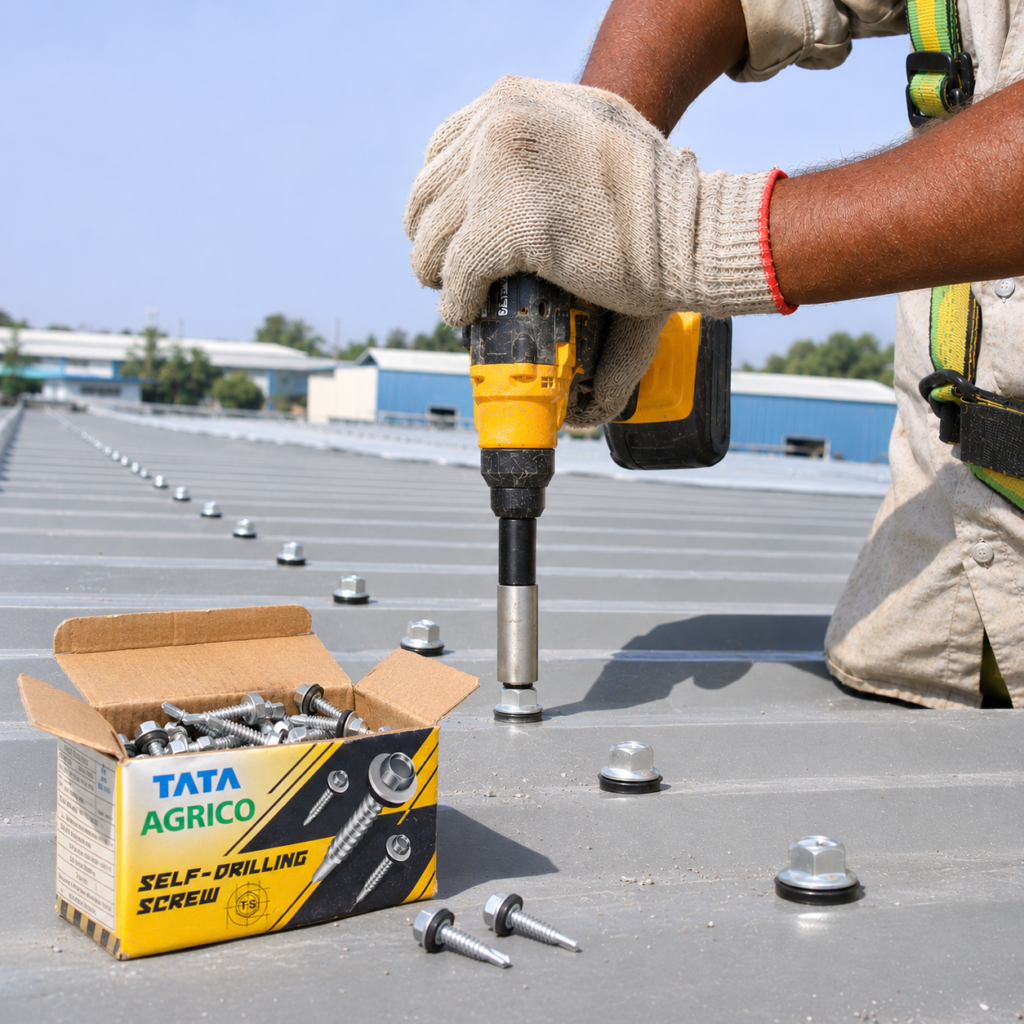
Crews fixing Tata screws in Chennai often work fast to finish before the afternoon heat, but rushing the gun can undo the screw’s design. Even a genuine screw can be let down by the wrong tool or technique.
- Use a screw gun with depth control, rather than an impact driver, so the final stage stops at the right point.
- Keep speed moderate. Very high speed overheats the drill point in stage two and dulls it before the hole is finished.
- Apply steady, straight pressure. Leaning the gun tilts the screw, which spoils centring in stage one and causes uneven washer seating in stage three.
Clear swarf from the roof after fixing, since leftover steel chips rust and stain the sheet.
Common Faults and Which Stage They Come From
Most fixing problems on site can be traced back to one of the three stages.
Screw skating across the sheet is a stage one problem. It usually comes from a worn tip or a gun held at an angle, so the point slides over the coating instead of biting into it.
A tip that burns out or snaps points to stage two. The drill point is often too small for the purlin thickness, or the gun is running too fast and overheating the cutting edges.
A screw that jams halfway happens between stage two and stage three. The threads have reached the steel before the hole is fully drilled, so the screw tries to grip and cut at the same time.
A washer that squeezes out or splits is a stage three fault caused by over-driving, often when an impact driver is used in place of a depth-controlled screw gun.
A leak around the screw head also starts in stage three. Under-driving leaves the washer loose, and an angled fixing stops it from sitting flat on the sheet.
Lookalike fasteners are a real concern for anyone buying Tata screws in Chennai, since many of these faults also appear with screws that do not match the real product’s steel, hardening or coating. Simple checks for spotting fakes are covered in our blog on genuine vs fake Tata Agrico screws.
A Simple Checklist When Buying Tata Screws in Chennai
Before placing an order for Tata screws in Chennai, run through these six checks.
Step 1: Check the purlin type and thickness Note whether the supports are cold-formed purlins or hot-rolled sections, and how thick they are.
Step 2: Select the drill point Choose a drill point rated for the full thickness of the purlin.
Step 3: Confirm the screw length Allow for sheet, any insulation and purlin thickness, with a few threads passing through.
Step 4: Check the washer and coating Use EPDM washers and a coating suited to coastal and humid conditions.
Step 5: Set up the tools Use depth-controlled screw guns at moderate speed and brief the crew on correct seating.
Step 6: Buy genuine stock Buy Tata screws in Chennai only from an authorized distributor so the screw performs as designed.
Conclusion
The three-stage drilling action is what lets a single screw pierce, drill, thread and seal in one smooth cycle. For contractors using Tata screws in Chennai, each stage has to work well, because the city’s mix of purlin types, sea air, heavy monsoon and daily heat leaves little room for a weak fixing.
As an authorized Tata Agrico distributor, Crayon Roofings & Structures helps contractors source genuine Tata screws in Chennai and pick the right size and drill point for each roof.
If you need help choosing Tata screws in Chennai for your next roofing project, contact us at Crayon Roofings & Structures to discuss your requirements.
Frequently Asked Questions
1. Can I get genuine Tata screws in Chennai from Crayon Roofings & Structures?
Yes. Crayon Roofings & Structures is an authorized Tata Agrico distributor, offering genuine self drilling screws for roofing projects in Chennai.
2. What is the three-stage drilling action of a self drilling screw?
The screw first centres and pierces the sheet, then drills through the purlin while clearing chips, and finally threads, clamps and seals.
3. Why do self drilling screws sometimes snap during fixing?
Snapping usually happens when the drill point is too small for the purlin or the threads reach the steel before the hole is finished.
4. Which factors should be considered when choosing Tata screws in Chennai?
Purlin thickness, drill point, screw length, washer type, coating, tool settings and buying from an authorized distributor should all be checked.